The Black Hole of the Camera

Me And You and Memento and Fargo


Putty Hill

After financing fell through on a scripted feature about teenage metal heads in Baltimore, entitled Metal Gods, Matthew Porterfield put together a five-page treatment based on people and locations he discovered while developing it. Shot guerrilla-style in 12 days, the result turned out to be Putty Hill. Porterfield’s semi-improvised second feature mixes a simple fictional premise – the overdose of a twenty-four-year-old drug addict named Cory – with documentary elements, such as direct interviews. Porterfield uses Cory’s death to explore reactions of relatives and friends within a working class neighborhood of Putty Hill on the outskirts of Baltimore. In the process, he captures a sense of dysfunction and alienation that rivals that found in Chris Fuller’s dark vision of his home town of St. Petersburg Florida, Loren Cass (2009), or Harmony Korine’s celebration of white trash culture, Gummo (1997).

Porterfield’s impressive first film, Hamilton (2006), about an unwed teenage mother and the baby’s father set in Baltimore, screened at a number of film festivals and independent showcases, including the Wisconsin Film Festival (which is where I saw it), before seeming to fade away. Putty Hill shares the same formal rigor of Hamilton. It consists of a series of loosely connected scenes that occur the day prior to Cory’s funeral, as well as one shot in his pad afterward. The film is less a portrait of Cory (whose photo we finally glimpse at the wake) than of the people who knew him and the places he inhabited. Only gradually does his younger cousin, Jenny (Sky Ferreira, the film’s only professional actress), emerge as the central character of this group portrait.

Although she wasn’t really close to Cory, Jenny returns from Santa Monica, California for the funeral. Earlier, her father Spike (Charles Sauers), a local tattoo artist, discusses his nephew’s death and his own troubled past with a client. In a long interview in which she rides in a taxi cab, Jenny, like Clarissa from River’s Edge (1987), worries about not being able to cry at the funeral, but reveals sad details about her conflicted relationship with her dad. Later that night, she breaks down after watching him apply a tattoo in subdued light as he and three black men do drugs. As she weeps uncontrollably on the porch, he claims not to understand her behavior.

In a sense, Spike’s bewilderment epitomizes the detachment that these characters seem to experience in the face of everyday life. None of them can really fathom Cory’s death. They know it’s a tragedy, but are incapable of mustering any semblance of emotional loss. As human beings, they’ve become deadened by alcohol and drugs, or distracted by paintball skirmishes, tattoos, BMX bikes and skateboard parks. All of them seem to live with their mothers – their fathers are conspicuously absent from their lives. After Cody and his brother, Dustin, return from paint balling, their mom sits at the kitchen table with Cody’s black girlfriend and baby. She strums a guitar and sings a song for him (about “looking for your brain”), but Cody stirs his coffee loudly and rudely leaves to go to the bathroom. And the assembled group at Cory’s funeral gathering can’t even let his mother, Cathy, deliver her eulogy without creating loud distractions that nearly drown out her words.

The pre-funeral party turns into a bizarre event. It’s held in a karaoke bar, where folks drink pitchers of beer. Someone does an off-key version of “Amazing Grace” (a last-minute replacement for the Rolling Stones’ song “Wild Horses” that created copyright problems), but it soon lapses into empty testimonials and spirited dancing that might seem more suited to a wedding. Cory’s grandmother, Virginia, who resides in a retirement home and smokes cigarettes, refuses to attend. She prefers denial to having to grapple with her feelings. If some of this at times contains an undercurrent of humor, it’s because Porterfield so clearly understands and appreciates the nuances of this subculture and has been able to nail the milieu so accurately.

Porterfield’s poetic sensibility is reflected in the film’s stunning shot compositions. His scenes unfold at a languid pace, but each is a feast for the eye, as well as the ear. Jeremy Saulnier, who, like Porterfield, attended NYU film school, has to be one of the most gifted indie cinematographers. In Putty Hill, he uses a dark muted palette and as little light as possible, so that you can’t help but be reminded of the work of Gordon Willis. One of the strongest scenes in the film is one of Spike giving a tattoo by flashlight. And the final one where Cory’s sister, Zoe, and a friend visit his deserted housde contains so little light we can’t really make out their identities for certain. The scene, however, provides a fitting bookend to the film’s opening shots of Cory’s place, in which light creates reflections on the wall.

Porterfield’s staging of scenes is extremely imaginative in terms of image and sound. In an early scene in which Spike gives the guy a tattoo, the buzz of the tattoo gun nearly drowns out their dialogue, so that Porterfield resorts to subtitles. In another early scene, four teenage girls hang out together on a couch. Two of them get up to have a cigarette.  The camera follows and frames them, but the remaining two offscreen are miked instead, causing a weird disjunction between what we’re hearing and seeing. When Zoe arrives in town for the funeral, she’s interviewed in front of a busy highway. In the night scene of the tattoo at Spike’s place, music drowns out the dialogue.

The director’s decision to use the documentary technique of interviewing the fictional characters is perhaps one of the most controversial aspects of Putty Hill. Who is the person asking the questions, and what is his relation to the narrative that is unfolding? Our local critic didn’t think it worked because he felt it created emotional distance from the characters. But with non-professional actors, who are not emotive to begin with, it tends to draw out the subjects, confusing the divide between subject and role in fascinating ways. Porterfield explains the strategy: “I guess I think about it as a disembodied voice – a voice coming from the camera – asking questions in the voice of the filmmaker, maybe the voice of the camera, but also the voice of the audience; but not as a physical body needing any reason to be there.”

Putty Hill provides additional proof of how digital cinema continues to transform indie film. It allows filmmakers such as Porterfield the liberty to shoot cheaply and quickly. In moving away from the written page, he’s been able to combine improvisation and visual storytelling as a means of providing a vitality that’s so often lacking in many conventional films today.

The film, which is being distributed by Cinema Guild, opened at the Sundance Cinemas Madison on Friday, two months after premiering in New York City. It will play for a week.

Posted 16 May, 2011

Prince of Broadway

Sean Baker has to be one of the most underrated young American indie filmmakers working today. After Four Letter Words (2000), he reinvented himself with two stellar features, namely Take Out (2004), which took years to screen theatrically, and Prince of Broadway (2010), which actually came out a couple of years ago. It played at the 2009 Wisconsin Film Festival, but only had its theatrical opening last September. Both Take Out and Prince of Broadway vied for the 2009 John Cassavetes Award (films made under $500,000). The double nomination probably hurt Baker’s chances of winning by splitting the votes he received.

A documentary-like look at an illegal immigrant Chinese delivery person in New York City, Take Out was shot in an actual Upper West Side restaurant during business hours, featured lots of b-roll shots, and interspersed actual orders with Baker and Shih-Ching Tsou’s fictional story. An added bonus was the candid responses of the various customers (solicited via Craigslist) to the home delivery person, Ming Ding (Charles Jang). Despite his desperate need to pay off pressing debts to loan sharks, Ming is much too shy and proud to play up to the customers in order to get bigger tips.

Prince of Broadway shares the same gritty realism as the previous film in telling the story of immigrants who sell counterfeit goods on the streets of New York City. One is a fast-talking West African hustler named Lucky (Prince Adu). The other is his boss, Levon (Karren Karagulian), a middle-aged Armenian from Lebanon, whose bare clothing store serves as a front for a secret back room full of luxury-brand knockoffs – from Gucci to Vuitton. Levon has married an attractive young woman in order to get a green card. Although he yearns for the relationship to be much more, it’s already on the skids.

The film’s catalyst occurs roughly twelve minutes into the film, when Lucky’s Latina ex-girlfriend, Linda (Kat Sanchez), dumps off a baby (Aiden Noesi), claiming that he’s the father. She tells him: “Be a man for once.” Linda indicates that it will only be temporary, but it soon becomes clear that the baby is interfering with a relationship she’s developed with a new boyfriend – a muscle-bound, jealous thug, who beats up Lucky when he chases after Linda. “I have no papers,” Lucky later pleads to her mother, “what can I do with this baby, please?”

Even though he’s an adult, Lucky is emotionally a child. When he gets the baby home, he lays down the law, telling him not to mess with his porno collection or his weed before breaking into tears. The eighteen-month-old baby, whom he eventually names Prince, is adorable, but Lucky only sees him as a burden. He complains constantly about his plight, not only to the uncomprehending toddler, but to anyone else who will listen. Most of his friends feel he’s being duped – the baby looks too light-skinned to be his kid. Prince also throws a wrench into Lucky’s relationship with his current girlfriend, Karina (Keyali Mayaga), who wants him to get an education. Like Take Out, Prince of Broadway has a ticking clock, in this case a DNA test to prove paternity, but Baker is careful not to use it in a heavy-handed way.

Not only does the film focus on the bond that slowly develops between Lucky and Prince, but it also centers on Lucky’s relationship with Levon, who serves as a father figure, even though he’s hardly the ideal role model. Levon asks him, “Do you know what you’re getting yourself into?” He gives Lucky money and instructions on how to hold the baby properly. He puts the baby’s hat on and tells Lucky, “Hold the kid, man. You’re going to drop the kid!” When Lucky doesn’t listen, he shouts, “Are you fucking kidding me? Hold the kid!” There have been a number of recent films that deal with the issue of fatherhood: Josh and Benny Safdie’s Daddy Longlegs, Winter’s Bone, The Kids Are All Right, and Life During Wartime. Prince of Broadway also has echoes of Ramin Bahrani’s Goodbye Solo, which also explored the experience of new immigrants in this country.

Baker likes to confuse and blend documentary and fiction. His films have a raw power that’s makes it seem as if he’s stuck his camera into real-life situations. The script is credited to Baker and his producer Darren Dean, but, as a final credit indicates, “the characters’ dialogue was realized through improvisation and a collaborative process with all actors.” As I keep writing about, many indie filmmakers have forsaken the well-written script in favor of structured improvisation. Baker, however, points out that there is often a stigma attached to working this way. He told an interviewer: “But [with Prince of Broadway] the improvised is simply the dialogue. Every scene had a beginning middle and end. It was just the dialogue. Some people think you are not doing your work if you don’t have the full fleshed out script.”

If the use of improvisation is becoming common in micro-budget indie films lately, the cutting in Baker’s films is quite unusual. In his excellent book The Way Hollywood Tells It, David Bordwell explores the concept of “intensified continuity” in depth and why the cutting of Hollywood films keeps getting faster. Indie films, especially naturalistic ones, have generally shared with art cinema a contrarian impulse – the story often unfolds in long, leisurely takes. Yet Baker fractures the space and time of his film through the use of manic cutting. An editor by profession, Baker’s impulse is to cut continually, which gives his film an exciting kinetic energy.

As a result, Prince of Broadway never feels boring. In exploring the subculture of those engaged in the underground economy, Baker provides an exciting glimpse into the lives of largely invisible characters who live on the margins.

Posted 18 February, 2011

Cold Weather

Aaron Katz’s Dance Party USA (2006) and Quiet City (2007) established his career as one of the best young independent American directors. Quiet City abandoned a written screenplay in favor of structured improvisation, allowing his actors – Cris Lankenau and Jamie Fisher – to improvise their scenes to the point where they shared screenwriting credit with the director. What serves to distinguish Katz’s films from those of his peers who employ similar strategies are strong formal concerns – his films are visually striking in ways that the work of certain other filmmakers simply aren’t. Memphis-based filmmaker Kentucker Audley, who made Team Picture (2007) and Open Five (2010), for instance, recently told an interviewer: “I try to be visually tame . . .  But I’m basically of the opinion that style is the easy part, and I always resist doing the easy thing.” Yet Katz’s films benefit precisely from the tension that arises between a casual approach to structure and working with actors and a more rigorous visual style. This holds true for his absorbing new film Cold Weather, a mystery set in his home town of Portland, Oregon.

Expectations ran high when, working on a larger budget (reportedly low six figures) after micro-budgets, Katz turned his attention to genre. We all remember what happened when David Gordon Green, who, like Katz, also graduated from the film program at North Carolina School of the Arts, tried to be more commercial by making Undertow (2004). After the brilliance of the character-based George Washington (2000) and All the Real Girls (2003), the genre elements in Undertow wound up seeming fairly contrived. Katz’s Cold Weather, on the other hand, manages to have fun with genre without getting too wrapped up in audience expectations of what needs to happen. Rather than an Agatha Christie-type mystery, Cold Weather might better be described as a slacker mystery, as epitomized by a stakeout scene in which the film’s protagonist, Doug, his co-worker, and then his sister sit in a car and eat “Swedish Fish” for several minutes. Adam Nayman in Cinema Scope talks about the film having “a crackling plot,” but, for me, Cold Weather uses plot merely as an opportunity to delve deeper into his characters.

Cold Weather begins with a shot of a rain splattered windowpane with the background out of focus, followed by a buoyant original score by Keegan DeWitt. The focus changes to reveal the courtyard of an apartment building, as a light rain falls. Doug (Cris Lankenau) enters carrying a large package. The shot cuts to Doug, a forensic science dropout, and his sister, Gail (Trieste Kelly Dunn), preparing a meal. There appears to be an awkward tension during dinner with their parents. Lankenau, looking scruffy and in need of a shave, proves that his endearing performance in Quiet City wasn’t a fluke. His self-deprecating demeanor once again gives him a certain charm. Lankenau has a way of breaking up his thoughts into discrete units, as if they comprise pieces of a puzzle. In response to his stepfather’s question how long he worked at an internship at a restaurant, he responds: “Two months. Like twenty hours a week . . . I mean I could have kept going, but I kind of quit . . . because . . . I didn’t get paid. And I started getting bored.” Doug discusses buying a coffee table – the large package we initially see him carrying. He tells his parents: “I’m assembling it. It’s coming right along . . . and by coming right along, I mean, not at all.”

The dialogue in Cold Weather involves excess verbiage; assertions end in negations. In the next scene, the camera focuses on a door that changes from yellow to cream color as Gail turns off the light and addresses Doug, who’s reading a book.

GAIL: All right. I’m going to go to bed now.
DOUG: Okay.
GAIL: Good night.
DOUG (sing song): Good night.
GAIL: You gonna go to bed soon?
DOUG: I don’t know. I’m not really tired.
GAIL: It weird you’re never tired.
DOUG: I’m tired in the morning.
GAIL: Yeah . . . me too. (After a very long pause) All right, I’m going to bed.
DOUG: Okay.
GAIL: Good night.
DOUG: Good night.

Screenwriting professors no doubt would flag the above dialogue as “chitchat,” but, as the scene indicates, we’re in the realm of naturalism. Between Gail’s first line and Doug’s last, the redundancy of their sentences merely attempts to fill up empty space between them, in a similar manner to Katz’s pans back and forth between the two characters. Gail’s pregnant pause indicates her concern for Doug, who is crashing with her. The next day he persuades her to skip out of work to go “whale watching” with him. The trip up the coast serves no narrative function other than to provide a sense of the Oregon landscape.

Doug’s takes a job at the ice factory, which provides Katz and his talented cinematographer Andrew Reed (using a RED camera) with an opportunity to explore an assembly line where bags of ice are produced. Doug meets a DJ co-worker, Carlos (Raúl Castillo), with whom he becomes fast friends, and at roughly fifteen minutes, he meets his ex-girlfriend, Rachel (Robyn Rikoon), at a coffee shop after she turns up unexpectedly from Chicago. She asks, “How’s living with your sister?” Rachel presses, “You like it more than living with me?” Surprisingly, he equivocates: “I don’t know, maybe not.”

The two guys and two women get together to play cards, which is followed by a montage that includes a spectacular shot: the camera slowly zooms in on Doug and Rachel as they stand on a bridge that overlooks a breathtaking waterfall. Carlos and Rachel attend a Star Trek convention together. Soon afterward, Carlos shows up at Doug’s apartment, informing him that Rachel never turned up at a club where she was supposed to meet him and is now missing. Carlos implores Doug to accompany him in investigating because he knows about “mysteries.” That may be true, but it’s Carlos who functions as the catalyst, while the more apathetic Doug gets dragged into getting involved.

I’ve gone into the film’s setup at some length, but I’ll not divulge the details of the mystery even though, on some level, the intricacies involving Rachel’s disappearance serve other purposes. As Doug attempts to solve the mystery, he and Gail grow closer together. Katz doesn’t poke fun at genre conventions; he takes them seriously despite having another agenda. There’s a hilarious cameo by Brendan McFadden (one of Katz’s collaborators) as Gail’s date, Swen. Katz’s other major collaborator, Ben Stambler, plays the hotel clerk, who gives knowing glances when Doug and Carlos rent a room together at Rachel’s motel. Another humorous exchange occurs later when Doug helps Gail navigate a porn site. She remarks, “You seem pretty familiar with how this kind of site works.” Doug’s response is a cold stare.

A Sherlock Holmes fan, Doug buys a cheap pipe to help him “think,” but we suspect the prop allows him to play the role better – even though he’s more like Frank or Joe Hardy than Holmes. The camera tracks through aisles of a grocery store and then the stacks of books in a library, creating a playful connection. Baseball figures prominently in the mystery, even though Doug obviously can’t hit a ball when he visits a batting cage, and Gail butchers the pronunciation of the name of ex-Yankee Clete Boyer. Late in the film, Doug follows a suspect into a building, where Reed’s slow zoom down a corridor is reminiscent of Ernie Gehr’s Serene Velocity. Earlier, the exterior of the motel has a lime-colored cast, while one of the occupied rooms is lit with a yellow filter. There’s also a memorable shot of Doug climbing stairs of a train overpass as the sun flares directly into the lens, illuminating both Doug and the structure with an intense reddish orange glow. One of the major strengths of Cold Weather is its extraordinary attention to visual details (which, I’d argue, is hardly the “easy part” of making a film).

As Katz points out, there are other films about brother and sister relationships, namely You Can Count on Me (2000) and The Savages (2007), but the relationships in those films are far more contentious. Cold Weather on the other hand, explores the subtle yet powerful impact that siblings, such as Gail and Doug, can have one another. Katz told Nayman: “I’m interested in the idea of siblinghood as a kind of co-dependency, at once very intimate and oddly removed – like when she tells him she had a boyfriend for six months and he has no idea.” Katz is exploring that odd sense of comfort that siblings often share from having grown up together, even though he adeptly buries the motivation of his characters. We never learn anything about Doug’s past relationship with Rachel or why they broke up. Doug seems unfazed by Rachel’s return, yet his dropping out of school and lack of direction might stem from the end of their relationship. Doug and Gail appear at ease with each other, but that’s not necessarily true of their own love relationships, which they each have greater difficulty navigating.

With Cold Weather, Aaron Katz has managed to achieve something very difficult, namely he’s made three terrific low-budget films in the past four years. Some months ago, I wrote a blog about the overemphasis on social networking as marketing tools for indie films. Katz weighed in on this subject in an interview in Filmmaker. He told Scott Macaulay: “The best thing, I think, is to make a film you feel proud of and then find an audience. But I’m for anything that can get people to see a movie. It’s when [these tools] become the dominant things, it sometimes feels they are not in service of the movies.” In this sense, Katz has his priorities straight.

Cold Weather is being distributed by IFC. The film premiered at South by Southwest and has been playing the festival circuit, but I’ve been waiting for it to surface theatrically. Cold Weather is now expected to open in February.

Posted 12 December, 2010

Meek’s Cutoff

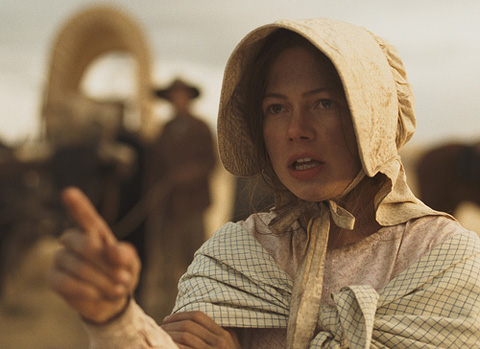
As a filmmaker, Kelly Reichardt is obviously on a roll. Following the critical successes of Old Joy (2006) and Wendy and Lucy (2008), expectations were enormously high for her latest film Meek’s Cutoff (2010), a period piece shot on 35mm with a budget much larger than usual. The film played at Venice, Toronto and twice at the New York Film Festival this past weekend. I’m glad I bought tickets to attend both of the NYC screenings because Meek’s Cutoff, which has been picked up for distribution by Oscilloscope Laboratories, turns out to be the best American indie film I’ve seen so far this year.

Meek’s Cutoff represents both a continuation and a departure for Reichardt. Jon Raymond, the gifted writer with whom she collaborated on her two previous efforts, came up with the idea and wrote the screenplay for Meek’s Cutoff, a “covered-wagon western” set in 1845. Despite Reichardt’s reluctance to discuss the new film in terms of genre, it’s impossible not to see the film as a revisionist western of sorts. In place of the hypermasculinity that characterizes the typical western, women play a crucial role in Raymond and Reichardt’s story. Whereas Old Joy and Wendy and Lucy tackle smaller themes – a relationship between old friends headed on different paths and a down-and-out young woman forced to decide what to do about her dog – Meek’s Cutoff is a pioneer tale about the settling of America.

Meek’s Cutoff tells the story of three families who have hired a mountain man named Stephen Meek (Bruce Greenwood) to lead them through the Cascade Mountains to the Willamette Valley on the other side. His shortcut – the “cutoff” of the film’s title – causes them to get lost in the vast desert area of Oregon. Whether it’s deliberate or the result of sheer incompetence we’re never quite sure, but the settlers express misgivings that Meek might be leading them astray for political reasons having to doing with immigration into the new territory. We learn this information early on as Emily Tetherow (Michelle Williams) and her older husband Solomon (Will Patton) walk through the dark night carrying lanterns.

Meek not only turns out to be an unreliable guide, but an insufferable blowhard, full of tall tales that make him instantly unlikeable. Meek has the strange habit of asserting one thing, but also suggesting that the opposite might be equally probable, which is to say that his judgments amount to useless double talk. The only blatantly clear aspect of Meek is his unbridled racism, especially regarding the indigenous American Indian tribes. This will come into bold play when a Cayuse Indian on horseback begins to shadow the settlers, as they traverse the harsh terrain alongside three covered wagons hitched to oxen.

After the settlers manage to capture the Cayuse, Meek assaults him and wants to kill him on the spot, but the rest decide the Indian could be useful in finding the water they so desperately need. In confronting the “Other,” the settlers attempt to communicate with the Indian (played by stuntman Rod Rondeaux), but, of course, language proves to be an obstacle and neither party can understand each other. As the settlers’ situation worsens, they begin to rely on the Indian to help them gain their bearings, but he proves to be an enigmatic figure. Emily tries to befriend the prisoner, but he spits out the food she gives him. After she mends his moccasin, he takes to carrying her sewing basket with him as they journey on. The Cayuse marks symbols on the rocks they pass. Is he sending messages to his tribe, or is it merely part of his religion? Thomas Gately (Paul Dano), whose wife Millie (Zoe Kazan) is starting to lose it, becomes convinced the former is the case, but Solomon persuades the group otherwise.

Raymond’s spare script actually contains very little dialogue. The film’s emphasis is on the daily labor of the characters, especially the women. With domestic chores to do, there’s little time for small talk or camaraderie. There is wood to collect, fires to make, dishes to scrub, clothes to knit, garments to wash and hang out to dry in the blazing sun. What’s striking about Meek’s Cutoff is the complete lack of sex involving any of the characters, but then again Reichardt’s major features River of Grass (1995), Old Joy, and Wendy and Lucy are among the chastest films in recent American indie cinema. Facing scorching heat and a scarcity of water, it’s understandable why survival rather than sex should be the main preoccupation of these settlers. Shot in 1.33:1 aspect ratio, Meek’s Cutoff is full of wide shots of the barren landscape, which serves to reinforce the formal space or distance between the characters. Chris Blauvelt’s extraordinary cinematography shifts from intense blue hues at the film’s opening to a warmer and washed out palette as the settlers and earth become parched from lack of water.

Characterization in Meek’s Cutoff is minimal. William White (Neal Huff), for instance, is devoutly religious. When he collapses from illness, the Cayuse stares at his shaking body and begins a medicine chant. Neither religion provides a cure. William’s wife, Glory (Shirley Henderson), is a bit on the ditsy side. She provides some of the only humor in the film, and even manages to get the other women to laugh at one point. If Solomon proves to be the most level-headed person of the bunch, Emily is the most compassionate and doesn’t hide her dislike of Meek from the very start. When he claims she must be flirting with him, Emily gives him a cold stare and insists he must not know anything about women. Meek proceeds to describe the female sex as “chaos” and the male sex as “destruction.” But when Meek gets out of line, it is Emily who stops him in his tracks.

Meek’s Cutoff unfolds at its own slow temporal pace, with shots lasting long enough for viewers to scrutinize what’s occurring within the frame. Reichardt’s film employs the type of narration we find in art cinema. Reichardt remarked after the Friday screening that until the film’s premiere screening at Venice she considered Meek’s Cutoff to be a “desert poem” rather than a western. And indeed, her work is profoundly poetic rather than narrative in its attention to small details and in its richly evocative qualities. Reichardt once again shows a mastery of visual storytelling. With the exception of Greenwood, her actors tend to be absorbed in physical actions, facial reactions, and communicating through body movements rather than dialogue. Michelle Williams and Will Patton, in particular, excel in giving restrained, naturalistic performances.

At least so far, Reichardt has proven to be the real deal as an indie filmmaker by not making films that can be read as industry calling cards. Even the release of Meek’s Cutoff was apparently delayed because Reichardt was teaching at Bard College and insisted on editing the film herself. In this tough economic climate, I try not to judge anyone because most indie filmmakers are struggling to survive these days. But Kelly Reichardt, as both Dennis Lim and Scott Foundas acknowledged in introducing her film at the festival, has somehow remained true to the vision of an independent cinema. Even though her budgets keep growing, she has not compromised her artistic integrity one bit.

Rather than wrapping up the minimal narrative with a sense of closure, Meek’s Cutoff ends with a question. Yet I found it amazing that audience members afterward really wanted Reichardt to interpret the film for them. They didn’t seem to understand that the film deals with the experience of being lost and living with uncertainty. Maybe the Cayuse knows where there’s water, but he makes no effort to communicate with the settlers. As a captive, why should he? Throughout the film, he speaks a language we can’t decipher, which somehow seems a key element in Reichardt’s new film. In the Q & A session at Toronto, according to Mark Olsen of the Los Angeles Times, the director commented: “We all know what happens, how it ends, there’s a golf course on the other side. You know, the bigger ending.”

Posted 13 October, 2010

The Kids Are All Right

It seems an accepted truism that family secrets need to be explored, especially if it involves children tracking down biological or estranged parents. No one ever considers that there might be negative consequences – a proverbial monster lurking in the closet, so to speak. In Lisa Cholodenko’s The Kids Are All Right, fifteen-year-old Laser (Josh Hutcherson) talks his eighteen-year-old half-sister, Joni (Mia Wasikowska), into contacting the sperm donor for their lesbian parents. Joni is about to go off to college and expresses reluctance, but all it takes to change her mind is for Laser to tell her, “I never ask you for anything.” Joni makes the phone call and the two secretly meet their sperm donor, Paul (Mark Ruffalo), a handsome restaurant owner and organic gardener. The initial verdict: Joni thinks he’s pretty cool, while Laser has some reservations, especially because Paul seems to be “a little into himself.”

The film’s hook is not only the quest to meet the sperm donor, but its exploration of a family with lesbian parents. Nic (Annette Bening), a successful doctor, is married to Jules (Julianne Moore), an airhead underachiever, who has decided to start a landscape design business. She’s already bought the truck, even though she doesn’t have any clients, which immediately becomes a source of friction. The bread winner/ piggy-backer dynamic will fuel their long-simmering conflict throughout the film. When they speak, the two often ask each other, “What do you mean?” It’s an odd question for a long-time couple to ask, but they clearly have issues to work out, as evidenced by Jules’s spotty employment record and Nic’s growing problems with alcohol.

Both Nic and Jules worry about their kids, and want them to be perfect, lest it reflect upon their lifestyle. Nic, for instance, insists that Joni write “Thank you” cards and Laser write a “Get well” card to a relative, reflecting her middle-class values. They’re concerned about Laser, however, who is hanging out with a psycho skateboarder named Clay (Eddie Hassell) and (unbeknownst to them) also snorting coke. Jules asks Laser, “What do you get from that relationship?” Male companionship might be one answer, but when Laser enviously watches Clay wrestle with his dad, we understand that there’s even more to it.

Nic and Jules actually think that Laser might be gay. And when they catch him and Clay viewing one of their own male porn videos one day, they interrogate him. Laser wants to know why they are into male rather than lesbian porn, but Jules insists, “It’s counter-intuitive.” Laser inadvertently spills the beans about the fact that he and Joni have met their sperm donor. The revelation sends his moms reeling. After Joni expresses the desire to see Paul again, Nic insists that she and Jules need to meet him first. At the arranged family meeting, Paul drives up on a motorcycle – shades of Marlon Brando in The Wild One.

Nic grills Paul about being in the “food services industry,” especially because his current interests – he turns out to be a college dropout – don’t appear to match the essay about himself he wrote years earlier. Nic wants to get rid of him pronto, but Paul hires Jules to do some landscape design work at his house. Once Jules starts working there, she can’t help but notice, “I see my kids’ expression in your face.” We suddenly know where this is heading. Paul has become smitten by the two kids for the very same reason. He spends time with Laser, who asks him why he donated sperm, which Joni earlier acknowledges is “pretty weird.” Paul answers that it was “more fun than donating blood,” then gives a more altruistic reason, and finally hedges. Laser asks him how much he got paid – a pittance – but Paul, staring at the results, insists that he’s glad he did it.

Lisa Cholodenko (High Art, Laurel Canyon) wrote the script for The Kids Are All Right with Stuart Blumberg over a five-year period. For her, it was an attempt to write something more mainstream than her previous indie films. Blumberg’s influence is in making the film more blatantly funny and having a more conventional structure. Indeed, the film initially feels like a comedy – not a broad comedy like the Duplass bothers’ Cyrus – but a comedy nonetheless. Much of The Kids Are All Right is indeed hilarious, especially Nic’s drunken anti-New Age rant about “heirloom tomatoes” and “composting” at a restaurant with friends, as she says things like “I like my wine! Okay! So fucking sue me!”

What I find most intriguing about The Kids Are All Right, however, is the undercurrent of melancholy that permeates the first two acts. The key scene occurs at a dinner at Paul’s house, where Nic, after some detective work in the bathroom and bedroom, figures out what’s been going on between Jules and Paul. The camera focuses on Nic’s face as she drinks a glass of wine, while the dinner conversation recedes and turns into a grating sound. The subsequent fight between the parents causes the kids to learn about the affair as well. The third act switches from comedy into melodrama, largely because it focuses on the effect that the revelation has on Joni and Laser.

Given its controversial sexual politics, The Kids Are All Right doesn’t take the easy way out. If the film sets out to answer the right-wing criticism of the effects of gay marriages on children, then the answer is the kids are fine. It’s the parents who aren’t. Like all long-term relationships, they are plagued by problems. Jules, in fact, gives an apologetic speech about marriage, in which, consciously or not, Moore seems to be channeling Carol White at Wrenwood in Safe, only she’s more articulate in this instance, as she tells the rest of them, “Marriage is fucking hard!”

The two screenwriters attempt to depict lesbian couples as being no different than straight ones, so The Kids Are All Right ends up being a defense of the nuclear family, warts and all. The parents might not love each other every minute, but they love their kids. But the kids might not love the parents nearly as much. When Nic and Jules demand hugs from Laser, he suggests they hug each other instead. At college, Joni, who still seems very sad and crushed by events, embraces Laser and remarks, “I’m sorry to leave you with them.” The moms then smother her and cry like babies, as we watch Joni’s bewildered and embarrassed response.

For Cholodenko, who is openly gay and raising a young child with her partner, and Blumberg, who had the experience of being a sperm donor while in college, there’s an autobiographical element to the film. The genesis of the script stemmed from Cholodenko’s fears that the biological father of her child might some day turn up unexpectedly. The Kids Are All Right, ends up casting Paul in the role of the repressed monster, who wreaks havoc of the family. Whether he deserves to be or not, he must nevertheless be villainized and expunged.

The Kids Are All Right is a well-made film pitched to the mainstream. I don’t have a problem with that, especially because, at least in the interviews I’ve read, Cholodenko hasn’t tried to suggest that the film is really “indie at heart” or any of those other disingenuous deceptions indie filmmakers use when they deliberately make something more commercial. The Kids Are All Right has a terrific cast: Julianne Moore, Annette Bening, and Mark Ruffalo. But, for me, Josh Hutcherson and Mia Wasikowska often steal the focus away from the stars through their subtle reactions and more understated and naturalistic style of acting.

Posted 25 July, 2010

« Previous Page
Next Page »