The Black Hole of the Camera

Me And You and Memento and Fargo


Best Independent Films of 2012

My best film list always appears in February, but I’m late this year, mainly because, even though I saw a streamed version of Julia Loktev’s The Loneliest Planet, I wanted to see it again in 35 mm. It played at our Cinematheque only last Friday. Yet, that issue aside, it’s been a hard year for me to keep up with the blog. Due to time constraints, I’ve been forced to be more selective in my coverage. As a general rule, I don’t write about films unless I’m enthusiastic about them and have an opportunity to view them at least twice.

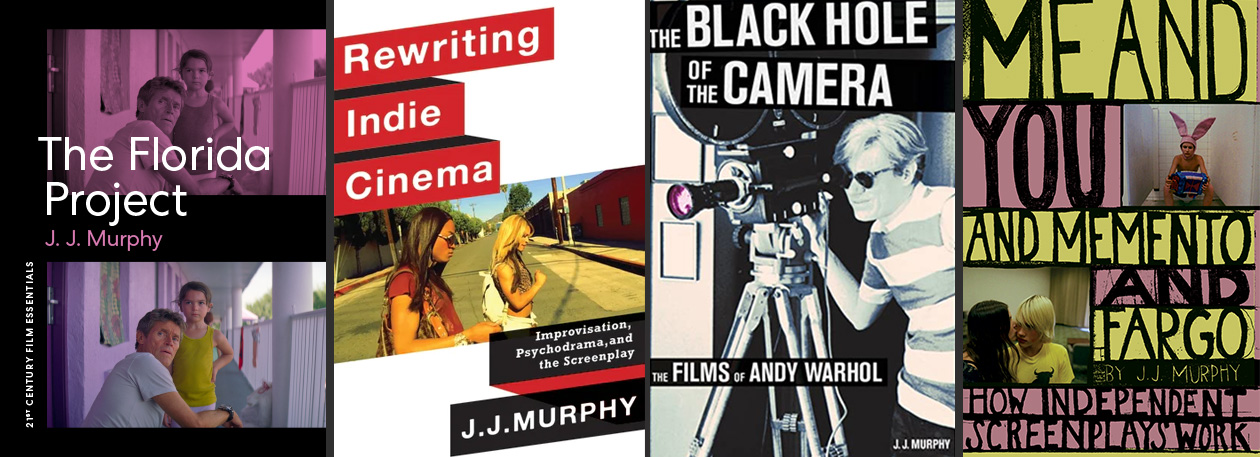
More of my attention this year went toward other pursuits. My book, The Black Hole of the Camera: the Films of Andy Warhol, was published by the University of California Press in April. As a result, I’ve been screening films and lecturing more than usual. I gave two conference papers, a couple of presentations at the Brakhage Symposium in Boulder, a keynote in Sydney, and screenings and talks in Milwaukee, Boston, and Houston in the fall. I’m also co-organizing, with my colleague Kelley Conway, an international conference on screenwriting. The 2013 SRN Screenwriting Conference will take place in Madison (August 20–22) and will feature 70 scholars from around the world.

On one level, I could complain that independent cinema seems to have fallen off a cliff. Although there are more films being made than ever before, getting them distributed has become even more difficult than in past years. Many people, especially those living outside major cities, don’t seem to want to leave their houses. People want their media when they want it, so streaming has become the preferred means of distribution, relegating DVDs to the latest casualty of the digital revolution.

The situation for indie cinema is a lot like in the 1960s. Now that there’s less prospect of there being a pot of gold out there for the grabbing, independent filmmakers, in some ways, are making the films they really want to make. I applaud that impulse. Greta Gerwig and Lena Dunham are now considered mainstream. You can make fun of mumblecore all you want, but it had an undeniable impact. By all accounts, 2013 promises to be a great year for independent cinema. Andrew Bujalski, Richard Linklater, Matthew Porterfield, David Lowery, Shane Carruth, Harmony Korine, and Jeff Nichols, among others, all have new films.

Most top ten lists are based on a film having a theatrical release. Using that criterion, Amy Seimetz’s Sun Don’t Shine, Dan Sallitt’s The Unspeakable Act, and Frank V. Ross’s Tiger Tail in Blue count for this year rather than last. The same goes for Tim Sutton’s Pavilion. I’m starting to feel that the line has become extremely blurry. I wrote about Bad Fever and Green ages ago. Chris Smith’s The Pool, which was listed in my 2008 poll, only recently made it out on DVD.

I’ve seen many of the films that made other more eclectic lists: Holy Motors, Amour, Cosmopolis, Tabu, The Master, Silver Linings Playbook, Moonrise Kingdom, The Kid with the Bike, In Another Country, and so forth. I also saw some wonderful avant-garde films, including several programs of Phil Solomon’s work, as well as programs by Vanessa Renwick and Stacey Steers during the past year. I also saw Chris Sullivan’s terrific animated feature, Consuming Spirits, but regret that I’ve only seen this new version once, and haven’t had the opportunity to write about it. I also try to follow what’s screening in museums and galleries. By far, the most impressive piece I saw was Eve Sussman’s self-generating and ever changing whiteonwhite:algorithmicnoir, made in collaboration with the Rufus Corporation. I found the interplay between the computer program and what appears on the screen to be utterly fascinating. I enjoyed the opportunity to discuss the work with the film’s actor, Jeff Wood, who spoke at the screening I attended in Houston.

Here is my list of the best indie films of 2012:

(Click on the titles below for extended commentary).

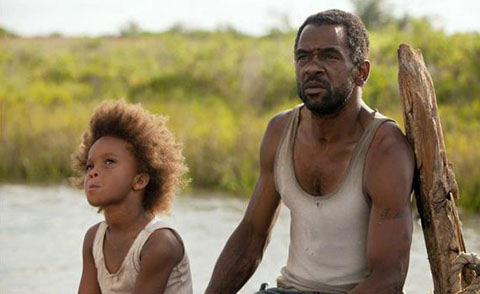
  1. Beasts of the Southern Wild (Benh Zeitlin)
  2. The Loneliest Planet (Julia Loktev)
  3. Two Years at Sea (Ben Rivers)
  4. Starlet (Sean Baker)
  5. The Dish & the Spoon (Alison Bagnall)
  6. The Color Wheel (Alex Ross Perry)
  7. Bad Fever (Dustin Defa)
  8. Green (Sophia Takal)
  9. Dark Horse (Todd Solondz)
  10. For Ellen (So Yong Kim)

I found the sheer ambition of Beasts of the Southern Wild to be totally impressive. It’s worth noting that Sean Baker has now made three strong films in a row, as has So Yong Kim. Julia Loktev’s The Loneliest Planet convinces me that she has emerged as a major American indie filmmaker. Loktev has indicated that the film was incredibly hard to shoot. To anyone who has ever made one, that’s pretty obvious. In terms of performance, I found the chemistry between Greta Gerwig and Olly Alexander in The Dish & the Spoon and between Dree Hemingway and Besedka Johnson in Starlet to be pretty riveting.

For purposes of comparison, you might want to check out my lists of “The Best Indie Films of 2011,” “The Best Indie Films of 2010,” “The Best Indie Films of 2009,” and “The Best Indie Films of 2008.”

Posted 28 February, 2013

Best Independent Films of 2010

I’ve posted my “best film” list for the past three years now in February rather than December like other critics and bloggers. The reason is simple. Because I’m based in the Midwest, I always want to be sure I’ve seen all the major indie films that might be worthy of consideration. As I keep complaining, despite my best efforts, that’s not an easy task these days. So it takes me a bit longer to catch up with all the films I want to see. That said, as it turns out, I could have posted this earlier because none of the additional films I watched ended up making the list.

Some “best film” lists have strict rules. One blog limits indie films to budgets of under $1 million. The budgets on my list vary a great deal, but most of them (with the exception of Life During Wartime, Greenberg and Winter’s Bone) are pretty miniscule. On the other hand, there are many films made for a pittance that I wouldn’t consider independent – they’re really industry calling cards. I have little personal interest in such films. Another list insists that a film play at least three times. That might work in New York City, but here we’re often lucky if a film like Manoel de Oliveira’s The Strange Case of Angelica plays even once. It did in January at our Cinematheque, and I was grateful for an opportunity to see it. To my great surprise, Trash Humpers played for a week. The two other people at the screening I attended left after ten minutes. At least people had a chance to see the film, but that’s often not the case, which continues to be the major problem for alternative cinema.

I liked quite a number of international art films this year: Fish Tank, Everyone Else, Mother, White Material and The Strange Case of Angelica, among others. But again the focus of this blog is American indie cinema, not because of chauvinism, but because that happens to be my main research interest. There are plenty of other Web Sites out there that cover other types of films.

My list surprised even me this time around, which I guess is part of the fun of the exercise. For the record, I’ve seen every film at least twice. In fact, I never write about a film on the basis of a single viewing. No film seemed to benefit more from a second look than Guy and Madeline on a Park Bench. Trash Humpers, while a polarizing film for audiences, also resonated more on a second viewing. Less than half of the films on the list had brief commercial runs in town (Madison, Wisconsin). Three of them played at the Wisconsin Film Festival.

I saw some excellent films and videos in art galleries and museums in NYC this year. Standouts include: Ryan McNamara’s dance piece, I Thought It Was You, Tommy Hartung’s stop-motion animation The Ascent of Man, and works by Kalup Linzy, Dani Leventhal (all seen at Greater New York at PS 1). I also admired Mika Rottenberg’s Squeeze at Mary Boone in conjunction with Nicole Klagsbrun Gallery.

In any event, here is my personal list of the best indie films of 2010:

(Click on the titles below for extended commentary).

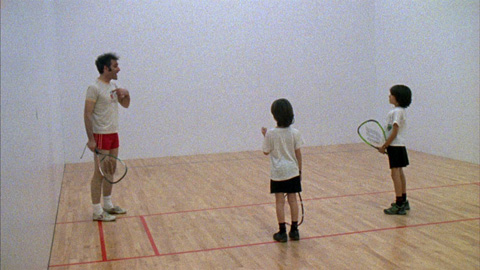
  1. Daddy Longlegs (Josh and Benny Safdie)
  2. Greenberg (Noah Baumbach)
  3. Winter’s Bone (Debra Granik)
  4. Face (Andy Warhol)
  5. Life During Wartime (Todd Solondz)
  6. Guy and Madeline on a Park Bench (Damien Chazelle)
  7. Tiny Furniture (Lena Dunham)
  8. Trash Humpers (Harmony Korine)
  9. The Exploding Girl (Bradley Rust Gray)
  10. Prince of Broadway (Sean Baker)

There were many extraordinary film performances this year: Greta Gerwig (Greenberg), Zoe Kazan (The Exploding Girl) , Jennifer Lawrence (Winter’s Bone), and Ronnie Bronstein (Daddy Longlegs).

For purposes of comparison, you might want to check out my lists of “Best Indie Films of 2009,” as well as the “Best Indie Films of 2008.”

Posted 23 February, 2011

Trash Humpers

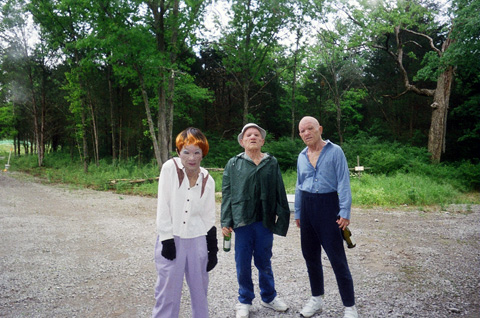
To many critics, Harmony Korine’s last feature Mister Lonely served notice that he had finally mellowed. News that he had gotten married, had a baby, and moved back to his hometown of Nashville was supposed to be the confirmation of this. Mister Lonely, his story about a Michael Jackson impersonator, was completely wacko, but it contained much more plot than usual, had big-name actors, and a much larger budget. In retrospect, Korine now expresses impatience about dealing with the logistics of such productions. His latest film returns to a DIY aesthetic with a vengeance. Shot on VHS, Trash Humpers revels in poor quality images that occasionally breakup, roll and drop out, while depicting a kind of unabashed freak show.

J. Hoberman calls Trash Humpers “a gloriously desultory slap in the face of public taste,” which seems a fair description. The film has the sensibility of a nightmarish carnival. Wearing geriatric masks, three characters – Korine calls them elderly “peeping Toms” – wander through a poor neighborhood of Nashville on crutches and in a wheelchair. They hump trash cans and trees, defecate, masturbate, light firecrackers, and generally wreck havoc by smashing everything in sight, especially old television sets. After destroying a television set and boom box, they tap dance gleefully in a parking lot at night, as a stream of cars pass by.

A young kid in a suit misses every attempt at getting a basketball through the hoop, as the old folks cackle at each failure. After they sing a song about a “Single Girl,” the kid takes a doll, shakes it vigorously and laughs maniacally. He says, “This is how you should do it.” The kid then shouts, “I told you I’d kill it, as he beats a doll with a hammer with such delight and enthusiasm that most viewers might be tempted to call Social Services. Equally disturbing is the scene where the elderly woman, “Momma” (Korine’s wife, Rachel), sits in a wheelchair and instructs the kid on how to put a razor blade in an apple – every parent’s Halloween nightmare.

The Siamese twins, Chang and Eng, make pancakes, as the others chant, “Make it, make it, don’t fake it.” When the twins serve them, Momma claims the food is poison. The old folks then force the twins to eat the pancakes doused in dish soap rather than maple syrup. Eng gives a speech about how nice it would be to live without a head: “Think how much money you would save on shampoos and hats.” He concludes: “And best of all, no one would get dizzy again.” Chang and Eng then tell a brief story about their lives, including Eng’s refusal to be separated by a doctor after Chang died. After Eng expires – his death is conveyed via a sock puppet – Momma yells, “I said make us laugh, motherfucker! That shit was depressing!”

Three women in skimpy underwear bend over on beds with their rear ends raised high in the air, while the old folks slap and feel their asses, all the time grunting and squealing with delight. The women then massage two of the old guy’s crotches while singing “Silent Night.” Someone sings a song about three little devils (“Three little devils jumped over the wall, chopped off their heads, and murdered them all”), as we see a naked and headless corpse in a field. A guy with white hair and a beard, dressed in a cocktail waitress outfit, delivers a poem while the old folks set off fire works. In the next scene, he lies in a pool of blood on the kitchen floor. Like the doll earlier, he appears to have been bludgeoned to death with a hammer.

Korine has always been interested in scenes rather than entire films. There’s the remarkable one of the young foul-mouthed cowboys robbing, molesting, and gay-baiting the androgynous skateboard hero, Bunny Boy, in Gummo. And when the blue-robed nun falls out of an airplane and flies through the air in Mister Lonely and we hear the incredible whooshing sound of the wind, it offers a visceral jolt that’s not easily forgotten. The episodic Trash Humpers, however, tries hard not to offer much in the way of conventional narrative pleasure, even in individual scenes.

Korine likes to be deliberately offensive. For instance, he includes a bad stand-up comic, who wears a neck brace and has his arm in a sling. He excels at telling very unfunny anti-gay jokes. Korine gives the guy enough rope to hang himself several times over. To mistake either the deranged kid in the suit, lessons on how to slip razor blades into apples, or the bad stand-up comic as speaking for Korine is to miss the point of his provocation. Korine is merely serving up the kind of fantasies that viewers might have of poor Tennessee neighborhoods.

Any interview with Korine, such as the one in Filmmaker with Scott Macaulay, who served as a producer on Gummo, is so tongue-in-cheek that even Korine had to laugh several times. I love it when he describes working together with his nearly blind editor in their underwear because of the intense heat. Korine continues: “He’s 75 percent blind, and we would just take apart the machines and I would always catch him sticking pencils in the VCR to give the footage these glitches.” That’s indicative of Korine’s special brand of vaudeville humor.

Trash Humpers abounds with references to other films and the art world. Besides many of the ones that Macaulay astutely mentions, Trash Humpers will remind viewers of the photographs of Diane Arbus, but even more of those of someone like Ralph Eugene Meatyard, an optician living in Lexington, Kentucky, who made creepy images of kids in masks in abandoned buildings and suburban backyards. Korine comes out of skateboard culture, and his work has been part of a Modern Gothic sensibility that has been in vogue in the art world since 9/11. He shares an obsession with death and the grotesque that we find in works by Banks Violette, Matt Greene, Sue de Beer, Olaf Breuning, and the sculptor David Altmejd.

Korine and Rita Ackermann currently have a collaborative exhibition based on Trash Humpers, entitled “Shadow Fux,” at the Swiss Institute in New York City. In an interview about the show, Korine and Ackermann attempt to invert the normal and the abnormal. Korine, for instance, responds: “Yeah, I mean, I married a woman who can swallow fifteen live goldfish in a single gulp. It doesn’t feel like that’s anything strange to me, it feels like there is a poetry to it. All that my neighbour does is steal yard furniture, he just goes around stealing it. He’s a very old man and that’s his hobby.”

As Jerry Saltz explains: “Indeed, almost all art that could be called Gothic has an ironic edge: It’s aware of its position, even the absurdity of its position, yet it persists with sincere tongue in ironical cheek.” Yet despite the film’s ironic stance, moments of genuine feeling manage to surface in Trash Humpers. In one of the later scenes, one of the elderly guys (played by the filmmaker) drives through the neighborhood and comments: “But sometimes when I drive through these streets at night, I could smell the pain of all these people living in here. I could smell how all theses people are just trapped in their lives, their day-to-day lives. They don’t see much.”

In Trash Humpers, the world may be represented as a weird, violent and crazy place, but it’s instructive to note that Korine’s film ends with a tender lullaby.

Postscript:

Last week, Jim Emerson over at “Scanners” had a post on Trash Humpers. Neither Jim nor his dog apparently cared for the film very much. But I was surprised that he thought that the controversy surrounding Netflix’s initial refusal to carry the film might have been a publicity stunt concocted by its distributor, Drag City. Jim writes: “So, maybe there was a bureaucratic snafu. Maybe Drag City made the whole thing up. I don’t know. But unless anyone has any proof (like a verified letter from Netflix outlining reasons for rejection, followed by another letter of acceptance), I guess I will have to remain skeptical.”

Well, I can’t provide legal documentation that would convince him, but I do have a former student, Mitch Bandur, who works at Drag City, and, based on an email I received from him some weeks ago about the incident, I do believe Drag City’s version of events – it wasn’t a publicity stunt at all. The larger issue has to do with the power and control that the bigger companies like Netflix and Amazon are gaining over distribution, especially over tiny distributors. In terms of Netflix, lately I’ve noticed that my “saved” queue (availability “unknown”) is getting to be larger than my regular queue. To me, that points to the simple fact that it’s getting harder and harder to view the indie films I really want to see.

Posted 16 January, 2011

Mister Lonely

It’s a sad comment on the state of indie film distribution and exhibition that most viewers have had to wait an entire year before seeing some of the films that played at last year’s Cannes Film Festival, in particular, Harmony Korine’s Mister Lonely (2007). Korine’s first feature in eight years opened theatrically yesterday through IFC First Take and is currently available on cable through VOD.

When asked about the commercial prospects for Mister Lonely, Korine gave his usual tongue-in-cheek response: “I remember thinking Gummo would be embraced by the public in much the same way as Bambi was when it first came out. I am always wrong about such things.” Korine has actually received more positive press than ever before – generally favorable reviews in the New York Times and Village Voice. His picture also graces the cover of the latest issue of Filmmaker, which features an informative interview with Korine by Michael Tully. In the intervening years, Gummo (1997) has been grudgingly acknowledged for the brilliant piece of filmmaking it is – as if anyone has forgotten the venomous attacks the film engendered upon release. The inclusion of Gummo in my book on independent screenwriting was in some ways a critical provocation – an effort to describe the associational, non-causal structure of the film – in the face of such hostility.

Much has been made of Korine’s substance-abuse problems and long road to recovery, suggesting that Mister Lonely presents a poignant, more mature side of the once bad-boy filmmaker. Korine’s personal breakdown, stint in rehabilitation, and subsequent comeback have been mentioned in virtually every article that appeared prior to the film’s release. And indeed it does seem relevant to Korine’s twin story of unrequited love between two celebrity impersonators and the faith of a group of nuns in their ability to fly. Sadly, both love and faith fail to save these characters from “a world that’s patiently waiting to take us away.”

Celebrity status came early to Korine. The self-taught filmmaker wrote the screenplay for Larry Clark’s Kids while a nineteen-year-old skateboarder. He made Gummo at twenty-three, an amazing accomplishment that was recognized by notable filmmakers, such as Werner Herzog, Gus Van Sant, and Bernardo Bertolucci, but not by most critics and moviegoers. Korine’s smart-aleck put-ons in interviews turned much of the media establishment against him. His appearances on David Letterman, while now staples on YouTube, were a form of exploitation, taking advantage of a young artist who made the fatal mistake of letting all the attention go to his head. Speaking about this, he told Dennis Lim, “It’s one thing to understand it intellectually, but another to live through it.”

Korine hasn’t lost his ability to embellish personal events in his life. In an interview with Lim in last Sunday’s New York Times, he talks about a fisherman’s wife walking an “invisible” dog and comments, “I mounted this leash on the wall and I heard it bark. I swear to you.” You have to admit it’s pretty comical when street magician David Blaine ends up being cast in the role of the straight man. In an interview with indieWIRE, Eric Kohn asks Korine whether he fabricated the story about “traveling with an Amazonian tribe called the Malingerers and searching for a mythological fish.” Korine answers, “Of course, this is the truth. In fact, I’m planning another trip back there soon. One of the members just gave birth to a twelve-pound baby with a fully grown tooth, and I am the godfather. Apparently, the child has been given my name.” Not since Andy Warhol, has anyone used the celebrity interview for such subversive ends.

Reportedly made for $9 million, and partially financed by French fashion designer Agnès b, Mister Lonely sounds even crazier than it actually is. A lonely Michael Jackson impersonator (Diego Luna) runs into a Marilyn Monroe wannabe (Samantha Morton) in a Paris café. She impulsively invites him to a Scotland commune of other impersonators – “a place where everyone is famous” – where she lives with her husband Charlie Chaplin and daughter, Shirley Temple. Other impersonators residing there include: Madonna, Sammy Davis Junior, Abe Lincoln, Buckwheat, James Dean, the Three Stooges. the Pope, Queen Elizabeth II, and one storybook character, Little Red Riding Hood. Set up as a utopian refuge, problems soon arise. The sheep wind up getting a livestock disease and have to be slaughtered. Chaplin becomes jealous over Marilyn’s obvious affections for Michael – she hugs him in the swimming hole – and becomes extremely abusive toward her. Marilyn tells him, “You know Charlie, sometimes when I look at you, you seem more like Adolph Hitler than Charlie Chaplin.” The impersonators decide to put on a talent show, which flops, leaving them all distraught. The situation with Marilyn ends in tragedy, causing Michael to return to Paris, where he abandons his life as an impersonator.

Korine creates another parallel story line involving a priest named Father Umbrillo (played by Werner Herzog), and a group of blue-robed nuns in Panama. Umbrillo is as much a dictator as Chaplin. In an early improvised scene, he scolds a poor man who turns up at the airport each day with flowers for his wife, who has left him. Umbrillo insists that the man admit his sins and repent, reducing him to tears. While airlifting food to a village, a nun suddenly falls out of the small plane – a truly dazzling sequence that by itself would make the film worth seeing. The subsequent shots of the nun falling through the air, coupled with the eerie sound of the wind, makes it seem as if we’ve suddenly entered a dream. The sound cuts out at one point; the nun prays, and a miracle occurs, as she eventually lands safely. Even her stagger upon trying to walk conveys the intensity of the experience, which far exceeds its seeming reference to popular culture. The plot thread involving flying nuns mirrors and reinforces the main plot with the impersonators.

Like many young independent filmmakers, Korine has an ambivalent relationship toward the script (which he co-wrote with his brother Avi). He told Tully: “I guess I have the script as just an outline, but the script is just words on paper – it’s just a start, a jumping-off point, at least for me. Everything is about the feel and about creating an environment. What I try to do, and what I’ve always tried to do, is, in some ways, mimic [the characters’] story [in the filmmaking]. Create a kind of universe. These characters are like chemicals, and you want to take those chemicals, put them in a bottle, shake them up, and then document the explosion.” Later in the same interview, Korine reiterates his lack of interest in straight narrative: “I’m starting to realize that when you play with narrative, or conventions of storytelling, it upsets a certain kind of person. Which I understand, you know, because you become interested in watching things with a beginning, a middle, and an end. Things that don’t necessarily shift in tone. But I don’t really make those types of movies.”

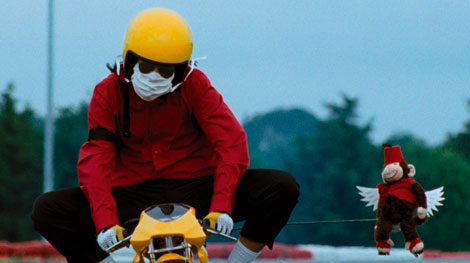
The types of characters and situations toward which Korine gravitates involve incongruities. You don’t have to look beyond Gummo’s Bunny Boy – a skinny, androgynous skateboarder with large pink rabbit ears – to find a more striking example. Mister Lonely begins and ends with a shot of the Michael Jackson impersonator. He wears a surgical mask and rides a clown bike in slow motion with a stuffed monkey with wings attached to the vehicle. This scene becomes emblematic of the film, but there are many other examples. For instance, Jackson performs to rap music in an old-age home, exhorting the elderly, “Don’t die. Live forever.” At the commune, James Dean hangs out with Little Red Riding Hood. As he rides a pony, Buckwheat, who sports a gigantic Afro, expresses his love of chicken breasts – “naked women” and “naked chicken.” The Pope proposes getting drunk for the sake of the soon-to-be-slaughtered sheep. He and the Queen later share a bed. The foul-mouthed Abe Lincoln blames the Three Stooges for the problems they’re having in setting up the talent show. He later can’t understand why the Stooges should go on stage before Madonna. A group of them decide that the Pope stinks, leaving Buckwheat to wash his back in an outdoor bathtub. When the Queen appears to speak following their performance, Korine makes her look more like the Infant of Prague, which is exactly the kind of silly joke that’s at the heart of Korine’s sense of humor.

Just as Korine employs Ron Orbison’s “Crying” to express the sadness of the dead cat Foot Foot in Gummo, he uses Bobby Vinton’s “Mister Lonely” as another pop song to convey the tragic feelings of estrangement felt by both the Michael Jackson and Marilyn Monroe impersonators, which they’re unable to bridge. That Korine would use Michael Jackson as a lead character is risky in and of itself these days. But it shows that Korine genuinely identifies with Jackson’s desire to stay a child forever and never grow up. When Michael Jackson tells his agent of his desire to quit being an impersonator, he counters, “Why do you want to be like everyone else. They’re all miserable.”

In a celebrity culture, ordinary folks are miserable because only fame really matters. Most people are rendered insignificant otherwise, and the culture makes us want to be other than ourselves, which is precisely what the Michael Jackson impersonator says in voiceover at the beginning of the film. Korine tackles issues of personal identity head on in Mister Lonely, which is best expressed in the lyrics of the title song: “I’ve been forgotten, yeah, forgotten, Oh how I wonder how is it I failed.” It’s hard not to read this and the entire film as a personal statement. Who could imagine Korine would make a film that is so naked and heartfelt that it has the raw emotional feel of a suicide note. And if you allow yourself to succumb to its considerable magic – thanks largely to the sensitive and spirited performances of both Luna and Morton – it might even leave you a bit teary-eyed.

Posted 3 May, 2008