The Black Hole of the Camera

Me And You and Memento and Fargo


Best Independent Films of 2012

My best film list always appears in February, but I’m late this year, mainly because, even though I saw a streamed version of Julia Loktev’s The Loneliest Planet, I wanted to see it again in 35 mm. It played at our Cinematheque only last Friday. Yet, that issue aside, it’s been a hard year for me to keep up with the blog. Due to time constraints, I’ve been forced to be more selective in my coverage. As a general rule, I don’t write about films unless I’m enthusiastic about them and have an opportunity to view them at least twice.

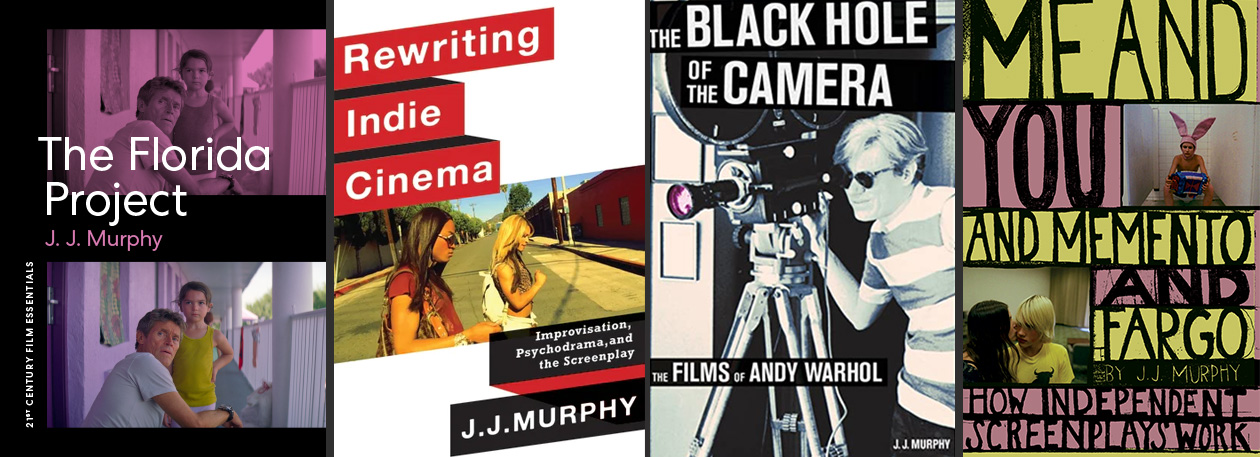
More of my attention this year went toward other pursuits. My book, The Black Hole of the Camera: the Films of Andy Warhol, was published by the University of California Press in April. As a result, I’ve been screening films and lecturing more than usual. I gave two conference papers, a couple of presentations at the Brakhage Symposium in Boulder, a keynote in Sydney, and screenings and talks in Milwaukee, Boston, and Houston in the fall. I’m also co-organizing, with my colleague Kelley Conway, an international conference on screenwriting. The 2013 SRN Screenwriting Conference will take place in Madison (August 20–22) and will feature 70 scholars from around the world.

On one level, I could complain that independent cinema seems to have fallen off a cliff. Although there are more films being made than ever before, getting them distributed has become even more difficult than in past years. Many people, especially those living outside major cities, don’t seem to want to leave their houses. People want their media when they want it, so streaming has become the preferred means of distribution, relegating DVDs to the latest casualty of the digital revolution.

The situation for indie cinema is a lot like in the 1960s. Now that there’s less prospect of there being a pot of gold out there for the grabbing, independent filmmakers, in some ways, are making the films they really want to make. I applaud that impulse. Greta Gerwig and Lena Dunham are now considered mainstream. You can make fun of mumblecore all you want, but it had an undeniable impact. By all accounts, 2013 promises to be a great year for independent cinema. Andrew Bujalski, Richard Linklater, Matthew Porterfield, David Lowery, Shane Carruth, Harmony Korine, and Jeff Nichols, among others, all have new films.

Most top ten lists are based on a film having a theatrical release. Using that criterion, Amy Seimetz’s Sun Don’t Shine, Dan Sallitt’s The Unspeakable Act, and Frank V. Ross’s Tiger Tail in Blue count for this year rather than last. The same goes for Tim Sutton’s Pavilion. I’m starting to feel that the line has become extremely blurry. I wrote about Bad Fever and Green ages ago. Chris Smith’s The Pool, which was listed in my 2008 poll, only recently made it out on DVD.

I’ve seen many of the films that made other more eclectic lists: Holy Motors, Amour, Cosmopolis, Tabu, The Master, Silver Linings Playbook, Moonrise Kingdom, The Kid with the Bike, In Another Country, and so forth. I also saw some wonderful avant-garde films, including several programs of Phil Solomon’s work, as well as programs by Vanessa Renwick and Stacey Steers during the past year. I also saw Chris Sullivan’s terrific animated feature, Consuming Spirits, but regret that I’ve only seen this new version once, and haven’t had the opportunity to write about it. I also try to follow what’s screening in museums and galleries. By far, the most impressive piece I saw was Eve Sussman’s self-generating and ever changing whiteonwhite:algorithmicnoir, made in collaboration with the Rufus Corporation. I found the interplay between the computer program and what appears on the screen to be utterly fascinating. I enjoyed the opportunity to discuss the work with the film’s actor, Jeff Wood, who spoke at the screening I attended in Houston.

Here is my list of the best indie films of 2012:

(Click on the titles below for extended commentary).

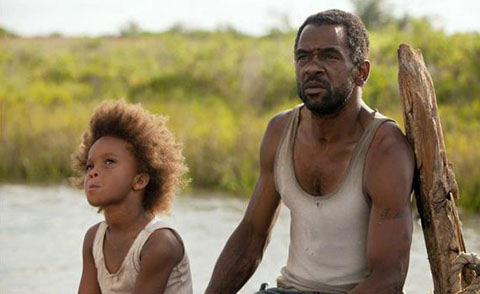
  1. Beasts of the Southern Wild (Benh Zeitlin)
  2. The Loneliest Planet (Julia Loktev)
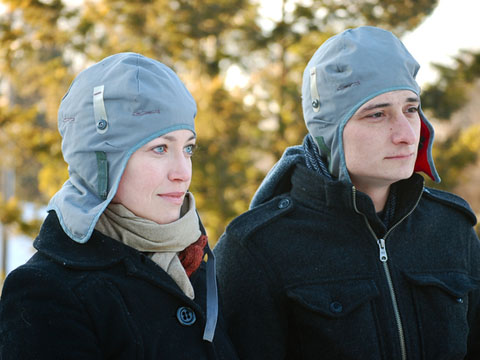
  3. Two Years at Sea (Ben Rivers)
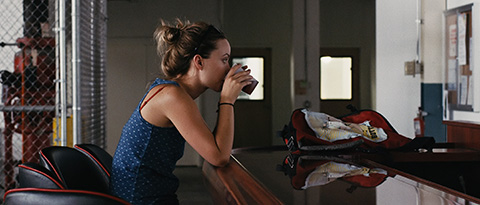
  4. Starlet (Sean Baker)
  5. The Dish & the Spoon (Alison Bagnall)
  6. The Color Wheel (Alex Ross Perry)
  7. Bad Fever (Dustin Defa)
  8. Green (Sophia Takal)
  9. Dark Horse (Todd Solondz)
  10. For Ellen (So Yong Kim)

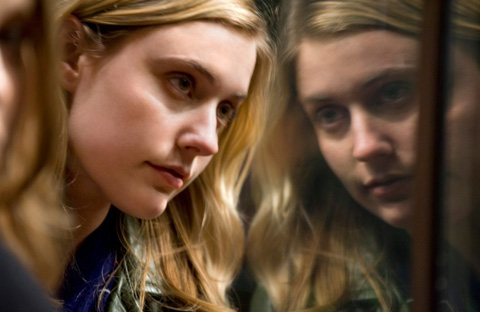
I found the sheer ambition of Beasts of the Southern Wild to be totally impressive. It’s worth noting that Sean Baker has now made three strong films in a row, as has So Yong Kim. Julia Loktev’s The Loneliest Planet convinces me that she has emerged as a major American indie filmmaker. Loktev has indicated that the film was incredibly hard to shoot. To anyone who has ever made one, that’s pretty obvious. In terms of performance, I found the chemistry between Greta Gerwig and Olly Alexander in The Dish & the Spoon and between Dree Hemingway and Besedka Johnson in Starlet to be pretty riveting.

For purposes of comparison, you might want to check out my lists of “The Best Indie Films of 2011,” “The Best Indie Films of 2010,” “The Best Indie Films of 2009,” and “The Best Indie Films of 2008.”

Posted 28 February, 2013

Tiger Tail in Blue

Although hardly unknown within indie film circles, the films of Frank V. Ross remain under the radar for more mainstream audiences. His new film, Tiger Tail in Blue (2012), represents his seventh feature since 2000, yet Ross, whose films have been associated with those of Joe Swanberg and Andrew Bujalski, has had trouble getting his films distributed more widely, despite playing at SXSW and other notable venues. Hopefully this is about to change. Tiger Tail in Blue was nominated for the “Best Film Not Playing at a Theater Near You” Award at the recent Gotham Independent Film Awards, and rated number five on the “Best Undistributed Films of 2012” list on Indiewire.

While showing similarities to films associated with mumblecore, Ross’s work mines somewhat different territory. In contrast to fellow Chicagoan Joe Swanberg, for example, Ross carefully scripts his films, even though they might easily be mistaken for being improvised. If early mumblecore films dealt with the confusion of twentysomethings jumpstarting their adult lives, Ross’s characters seem to be a very different breed. They are less urban hipsters in a transitional stage of life than young, working-class suburbanites, who find themselves already trapped in humdrum lives and less than satisfying routines. They accept their fates with a certain resignation, yet feel stymied and unfulfilled as they struggle to make ends meet in a world of diminished prospects.

In Hohokam (2007), which is set in sweltering Phoenix, Anson (Anthony J. Baker) is an ex-marine working as a laborer, while his girlfriend Lori (Allison Latta) is stuck in a cramped office cubicle where she haggles on the phone with customers about their late medical payments. Anson has aspirations to start a restaurant or a car wash, but it’s not clear that he has the necessary drive, skills or luck to make that happen. To make matters worse, even Lori has her doubts. In Audrey the Trainwreck (2010), Ron Hogan (Baker), works as a purchaser for an ATM parts company, while the new girlfriend he meets on an Internet dating site, Stacy (Alexi Wasser), delivers parcels. It turns out that Ron hates his job, but can’t admit it to himself. In fact, he’s already secretly counting the days to early retirement (the working class dream), even though he’s only been employed there for three years.

If dead-end jobs largely define the worlds of Ross’s characters, they also consume so much of their lives that they don’t have much time for leisure. But the characters also appear to live in a cultural and artistic vacuum. In Hohokam, Anson and Lori decide to go out on the town and do something, but they are somewhat at a loss to figure out what that might be. For lack of anything better to do, they end up visiting the local zoo. In Audrey the Trainwreck, Ron spends time in coffee shops and dark bars. Beyond that, he plays volleyball with co-workers, while Stacy attends a bridal shower. The main characters in Tiger Tail in Blue go sledding down a not-very-steep hill.

What’s unique about Ross’s films is the way he deliberately eschews classical narrative. There’s no catalyst or inciting incident 10 or 15 minutes into the film to propel the story forward. In fact, there’s not much story per se. Viewers expecting a dramatic premise might question exactly what it is they’re watching. Yet Ross merely has a different agenda. He’s less interested in story conventions than in exploring the boundaries of narrative. At times, he even teases viewers by playing with their expectations. There is Anson’s gun, Lori’s flirtatious officemate, and another co-worker named The Jeffery (Joe Swanberg), who weasels a ride home from Lori early in Hohokam. Plotwise, these all turn out to be red herrings. In Audrey the Trainwreck, Ron’s roommate, Scott Kaniewski (Danny Rhodes) appears to have a crush on him, but this doesn’t lead anywhere either, and is treated as a simple fact of life. If there’s a story there, Ross chooses not to tell it.

Ross seems to exult in chronicling the ordinary or the mundane. He gives equal weight to what would be excluded in most other films: bodily functions, pumping gas, office rumors, a phone call from a child that turns out to be a wrong number, breaking a favorite coffee mug, an older couple dancing in a restaurant, the surprise of getting a buffalo head nickel, the pleasure of a doughnut break or eating ice cream, the annoyance of cell phones, or a bad case of shingles. Ross’s characters talk very matter-of-factly, even provocatively, about sex, but the erotic pleasure appears to be more in talking about it – the possibility of sex – rather than actually engaging in the act. Any declaration about making love becomes an empty threat.

The sense that Ross’s characters feel trapped in their suburban lives and by jobs that “suck the life out of them” probably accounts for the fact that they get easily annoyed by little things. Ron gets upset about restaurants that claim to have the best hamburgers; the bride-to-be complains to Stacy about a parent interfering with her wedding plans. Chris in Tiger Tail in Blue gets irritated by older folks who call him “dude,” while Brandy’s roommate, Leonard (Baker), is convinced that reality television is making kids stupid. Scott launches into a long tirade, lasting several minutes, about security screenings of children at airports. He insists he’d rather be blown up than subjected to such “indignities.” “Just agree with me,” Scott heatedly vents to Ron, “that kids taking off their shoes at airports equals a shitty world.”

Ross’s characters also tend to have very short fuses. Lori and Anson get into an argument over an offhanded racist comment. Lori’s failure to approve of Anson’s choice of clothes leads to a blowup that causes her to storm out of the house. During a game of volleyball, Ron angrily throws the ball at his co-worker Jeremy (Swanberg) after he slips on water that Jeremy accidentally spills on the court. Ron argues with Scott, and also gets into an altercation at the local bar with a smug contractor named David (Nick Offerman), who belittles the significance of Ron’s line of work. It’s the kind of situation we fully expect will escalate into a fistfight, but, in this case, David’s wife wisely intervenes before the two come to blows.

Ross’s films present slices of life rather than conventional narratives. They are not easily summarized or explained. In some sense they are character studies of couples. Anson and Lori seem to be a mismatched pair. They don’t have very much in common, and she finds it weird that he walks around with a loaded gun. In fact, Lori seems to share greater camaraderie with her gay friend, Guy (Rhodes) than with Anson. Audrey the Trainwreck explores the life and frustrations of a single guy who’s starting to get up there in age, but is still on the prowl, painfully aware that the clock is ticking and his prospects are narrowing. Tiger Tail in Blue examines the pressures of everyday life on a young married couple in suburban Chicago.

Tiger Tail in Blue feels less angry than Ross’s previous films. If Audrey the Trainwreck accentuates warmer, yellow and orange hues, Mike Gibisser’s assured cinematography gives the new film a cooler, bluish look, as befits the melancholic mood suggested by the title, and which is reinforced by the jazz score by Mike Medeski and Chris Speed. Ross has always excelled at getting strong naturalistic performances from his actors, and Tiger Tail in Blue uses an ensemble cast – Ross himself and Rebecca Spence, along with Megan Mercier and Anthony Baker in a cameo – to great effect. Ross continues to be the master of throw-away lines. If the anger has dissipated somewhat, it nevertheless lurks just under the surface, so that Tiger Tail still retains its edge. Ross is keenly observant of human behavior. The simplicity of Tiger Tail turns out to be a deceptive mask.

In Tiger Tail in Blue, Chis (Ross) is an aspiring writer, who also works nights as a waiter, while his wife, Melody (Rebecca Spence), is a high school teacher. As a result of their conflicting schedules, the two hardly see each other. Melody is already asleep by the time Chris gets home, which puts strain on their love life. Not only do their different work schedules create enormous tension between them, but Chris also flirts with a co-worker named Brandy, which causes him to linger at the restaurant even longer. Melody resents Chris’s aspirations to be a writer, especially because it affects them financially. To her, his pursuit of writing is a luxury they can’t afford. When Chris is late coming up with his share of expenses, it leads to a spat. They also get into an argument later when Chris needs Melody to give him a ride home after he has his eyes dilated. Melody’s resentment becomes evident when she refers to their health insurance as “my” insurance. She’s the one who has the job with benefits, even though she might not be able to keep it long-term.

Ross’s films have cryptic titles. They don’t actually describe the films they represent, but rather resonate in idiosyncratic ways. Hohokam suggests that Phoenix is less a mecca for young singles than a dying civilization. Audrey the Trainwreck refers to a drunken woman on the dance floor that Scott describes to Ron, while Tiger Tail in Blue alludes to the type of doughnuts that Chris and Melody eat on the street. For this couple, stopping for doughnuts represents one of the few pleasures in life that breaks the monotony of their daily grind. Ross’s films usually incorporate unexpected elements. In Tiger Tail in Blue, the film’s naturalism is confounded by the fact that Spence plays not only Chris’s wife, Melody, but also Brandy, the waitress with whom he works.

While this is initially confusing, a different actress (Megan Mercier) takes over the role at two crucial points in the film. The first occurs when Melody pays an unexpected visit to the restaurant; the second happens when Chris comes over to Brandy’s house to borrow a CD. Ross is not the only filmmaker to cast the same performer in different roles, but a viewer might question why he employs this unusual strategy here. Ross’s point seems to be that Chris’s feelings toward Melody and Brandy are tempered by the situation. Work allows Chris and Brandy the space to enjoy each other’s company, whereas the responsibilities of marriage conspire to snuff out the spark of romance between Chris and Melody.

Ross, in fact, states it bluntly in an interview with Hammer to Nail: “I mean, romance goes away at a certain point. You displace your feelings after a certain amount of time, it’s kind of like, ‘Oh wasn’t it fun when we did this?’ But it’s a new relationship now, and if you can’t enjoy it, you’re going to, you know, do what happens in the movie.” The film’s loopy song-and-dance number perfectly embodies Chris’s personal dilemma. A curious amalgam of a Fred Astaire and Ginger Rogers musical and a John Wayne western, the scene is so playful and exhilarating that its tonal shift catches us completely by surprise.

Along with Amy Seimetz’s Sun Don’t Shine (which was just acquired by Factory 25) and Dan Sallitt’s The Unspeakable Act, Tiger Tail in Blue strikes me as one of the best indie films to surface in the past year. The film will play at the Gene Siskel Film Center in Chicago later this month and at the Wisconsin Film Festival in April.

Posted 18 January, 2013

Cold Weather

Aaron Katz’s Dance Party USA (2006) and Quiet City (2007) established his career as one of the best young independent American directors. Quiet City abandoned a written screenplay in favor of structured improvisation, allowing his actors – Cris Lankenau and Jamie Fisher – to improvise their scenes to the point where they shared screenwriting credit with the director. What serves to distinguish Katz’s films from those of his peers who employ similar strategies are strong formal concerns – his films are visually striking in ways that the work of certain other filmmakers simply aren’t. Memphis-based filmmaker Kentucker Audley, who made Team Picture (2007) and Open Five (2010), for instance, recently told an interviewer: “I try to be visually tame . . .  But I’m basically of the opinion that style is the easy part, and I always resist doing the easy thing.” Yet Katz’s films benefit precisely from the tension that arises between a casual approach to structure and working with actors and a more rigorous visual style. This holds true for his absorbing new film Cold Weather, a mystery set in his home town of Portland, Oregon.

Expectations ran high when, working on a larger budget (reportedly low six figures) after micro-budgets, Katz turned his attention to genre. We all remember what happened when David Gordon Green, who, like Katz, also graduated from the film program at North Carolina School of the Arts, tried to be more commercial by making Undertow (2004). After the brilliance of the character-based George Washington (2000) and All the Real Girls (2003), the genre elements in Undertow wound up seeming fairly contrived. Katz’s Cold Weather, on the other hand, manages to have fun with genre without getting too wrapped up in audience expectations of what needs to happen. Rather than an Agatha Christie-type mystery, Cold Weather might better be described as a slacker mystery, as epitomized by a stakeout scene in which the film’s protagonist, Doug, his co-worker, and then his sister sit in a car and eat “Swedish Fish” for several minutes. Adam Nayman in Cinema Scope talks about the film having “a crackling plot,” but, for me, Cold Weather uses plot merely as an opportunity to delve deeper into his characters.

Cold Weather begins with a shot of a rain splattered windowpane with the background out of focus, followed by a buoyant original score by Keegan DeWitt. The focus changes to reveal the courtyard of an apartment building, as a light rain falls. Doug (Cris Lankenau) enters carrying a large package. The shot cuts to Doug, a forensic science dropout, and his sister, Gail (Trieste Kelly Dunn), preparing a meal. There appears to be an awkward tension during dinner with their parents. Lankenau, looking scruffy and in need of a shave, proves that his endearing performance in Quiet City wasn’t a fluke. His self-deprecating demeanor once again gives him a certain charm. Lankenau has a way of breaking up his thoughts into discrete units, as if they comprise pieces of a puzzle. In response to his stepfather’s question how long he worked at an internship at a restaurant, he responds: “Two months. Like twenty hours a week . . . I mean I could have kept going, but I kind of quit . . . because . . . I didn’t get paid. And I started getting bored.” Doug discusses buying a coffee table – the large package we initially see him carrying. He tells his parents: “I’m assembling it. It’s coming right along . . . and by coming right along, I mean, not at all.”

The dialogue in Cold Weather involves excess verbiage; assertions end in negations. In the next scene, the camera focuses on a door that changes from yellow to cream color as Gail turns off the light and addresses Doug, who’s reading a book.

GAIL: All right. I’m going to go to bed now.
DOUG: Okay.
GAIL: Good night.
DOUG (sing song): Good night.
GAIL: You gonna go to bed soon?
DOUG: I don’t know. I’m not really tired.
GAIL: It weird you’re never tired.
DOUG: I’m tired in the morning.
GAIL: Yeah . . . me too. (After a very long pause) All right, I’m going to bed.
DOUG: Okay.
GAIL: Good night.
DOUG: Good night.

Screenwriting professors no doubt would flag the above dialogue as “chitchat,” but, as the scene indicates, we’re in the realm of naturalism. Between Gail’s first line and Doug’s last, the redundancy of their sentences merely attempts to fill up empty space between them, in a similar manner to Katz’s pans back and forth between the two characters. Gail’s pregnant pause indicates her concern for Doug, who is crashing with her. The next day he persuades her to skip out of work to go “whale watching” with him. The trip up the coast serves no narrative function other than to provide a sense of the Oregon landscape.

Doug’s takes a job at the ice factory, which provides Katz and his talented cinematographer Andrew Reed (using a RED camera) with an opportunity to explore an assembly line where bags of ice are produced. Doug meets a DJ co-worker, Carlos (Raúl Castillo), with whom he becomes fast friends, and at roughly fifteen minutes, he meets his ex-girlfriend, Rachel (Robyn Rikoon), at a coffee shop after she turns up unexpectedly from Chicago. She asks, “How’s living with your sister?” Rachel presses, “You like it more than living with me?” Surprisingly, he equivocates: “I don’t know, maybe not.”

The two guys and two women get together to play cards, which is followed by a montage that includes a spectacular shot: the camera slowly zooms in on Doug and Rachel as they stand on a bridge that overlooks a breathtaking waterfall. Carlos and Rachel attend a Star Trek convention together. Soon afterward, Carlos shows up at Doug’s apartment, informing him that Rachel never turned up at a club where she was supposed to meet him and is now missing. Carlos implores Doug to accompany him in investigating because he knows about “mysteries.” That may be true, but it’s Carlos who functions as the catalyst, while the more apathetic Doug gets dragged into getting involved.

I’ve gone into the film’s setup at some length, but I’ll not divulge the details of the mystery even though, on some level, the intricacies involving Rachel’s disappearance serve other purposes. As Doug attempts to solve the mystery, he and Gail grow closer together. Katz doesn’t poke fun at genre conventions; he takes them seriously despite having another agenda. There’s a hilarious cameo by Brendan McFadden (one of Katz’s collaborators) as Gail’s date, Swen. Katz’s other major collaborator, Ben Stambler, plays the hotel clerk, who gives knowing glances when Doug and Carlos rent a room together at Rachel’s motel. Another humorous exchange occurs later when Doug helps Gail navigate a porn site. She remarks, “You seem pretty familiar with how this kind of site works.” Doug’s response is a cold stare.

A Sherlock Holmes fan, Doug buys a cheap pipe to help him “think,” but we suspect the prop allows him to play the role better – even though he’s more like Frank or Joe Hardy than Holmes. The camera tracks through aisles of a grocery store and then the stacks of books in a library, creating a playful connection. Baseball figures prominently in the mystery, even though Doug obviously can’t hit a ball when he visits a batting cage, and Gail butchers the pronunciation of the name of ex-Yankee Clete Boyer. Late in the film, Doug follows a suspect into a building, where Reed’s slow zoom down a corridor is reminiscent of Ernie Gehr’s Serene Velocity. Earlier, the exterior of the motel has a lime-colored cast, while one of the occupied rooms is lit with a yellow filter. There’s also a memorable shot of Doug climbing stairs of a train overpass as the sun flares directly into the lens, illuminating both Doug and the structure with an intense reddish orange glow. One of the major strengths of Cold Weather is its extraordinary attention to visual details (which, I’d argue, is hardly the “easy part” of making a film).

As Katz points out, there are other films about brother and sister relationships, namely You Can Count on Me (2000) and The Savages (2007), but the relationships in those films are far more contentious. Cold Weather on the other hand, explores the subtle yet powerful impact that siblings, such as Gail and Doug, can have one another. Katz told Nayman: “I’m interested in the idea of siblinghood as a kind of co-dependency, at once very intimate and oddly removed – like when she tells him she had a boyfriend for six months and he has no idea.” Katz is exploring that odd sense of comfort that siblings often share from having grown up together, even though he adeptly buries the motivation of his characters. We never learn anything about Doug’s past relationship with Rachel or why they broke up. Doug seems unfazed by Rachel’s return, yet his dropping out of school and lack of direction might stem from the end of their relationship. Doug and Gail appear at ease with each other, but that’s not necessarily true of their own love relationships, which they each have greater difficulty navigating.

With Cold Weather, Aaron Katz has managed to achieve something very difficult, namely he’s made three terrific low-budget films in the past four years. Some months ago, I wrote a blog about the overemphasis on social networking as marketing tools for indie films. Katz weighed in on this subject in an interview in Filmmaker. He told Scott Macaulay: “The best thing, I think, is to make a film you feel proud of and then find an audience. But I’m for anything that can get people to see a movie. It’s when [these tools] become the dominant things, it sometimes feels they are not in service of the movies.” In this sense, Katz has his priorities straight.

Cold Weather is being distributed by IFC. The film premiered at South by Southwest and has been playing the festival circuit, but I’ve been waiting for it to surface theatrically. Cold Weather is now expected to open in February.

Posted 12 December, 2010

Greenberg

It was inevitable that if the young filmmakers associated with mumblecore couldn’t capitalize on the phenomenon at the box office someone else would. Films like The Puffy Chair (2006), Baghead (2008), and Humpday (2009) were all expected to become commercial successes, but all of them fizzled badly. Noah Baumbach, who somewhat surprisingly produced Joe Swanberg’s Alexander the Last (2009), shot his latest film Greenberg (2010) with mumblecore mainstays Mark Duplass and Greta Gerwig.

Just as John Schlesinger turned themes that Andy Warhol was exploring in My Hustler into the Academy-Award winner Midnight Cowboy (1969) with Jon Voight playing a male prostitute, so too has Focus Features’ Greenberg mined territory similar to mumblecore, while far exceeding the success of probably all of those films combined. Greenberg, in a limited theatrical release, has already grossed $3 million domestically. Of course, I’m being deliberately provocative in my analogy. Noah Baumbach is hardly John Schlesinger, and none of the mumblecore directors are in the same league as Andy Warhol. But the surprise here is less that Baumbach’s Greenberg is a modest commercial and critical hit than the fact that he has managed to turn Greta Gerwig into an overnight star.

A. O. Scott’s glowing article on Gerwig in the Sunday New York Times two weeks ago might have seemed over the top to many people. He writes: “Ms. Gerwig, most likely without intending to be anything of the kind, may well be the definitive screen actress of her generation, a judgment I offer with all sincerity and a measure of ambivalence. She seems to be embarked on a project, however piecemeal and modestly scaled, of redefining just what it is we talk about when we talk about acting.” Because acting is the one aspect of a film about which people most disagree, I’m pretty sure that The New York Times received a great deal of flack over this claim about Greta Gerwig.

There are several different types of film acting. “Star” acting aside, Hollywood acting, as embodied by someone like Meryl Streep, is the kind in which the artifice is completely evident in her performance. Every emotion is being telegraphed to us as viewers. In other words, when watching such performances, I’m always aware of exactly what the performer is doing – there’s never really a suspension of disbelief. Indeed, the performance in question is judged precisely on recognizing the divide between actor and role. Did you really believe for a second that Jon Voight was a male hustler? Probably not, but mainstream viewers appreciated his characterization rather than its sense of realism.

Think of Sissy Spacek and Tom Wilkinson in the scene where the Fowlers rip each other to shreds in Todd Field’s In the Bedroom. That’s Hollywood acting, as we watch how the two veteran actors build their performances step by step. I’m not saying that what they are doing isn’t powerful or emotionally affecting – with artifice it is always a question of degree. In Gus Van Sant’s My Own Private Idaho, there’s the scene where Mike (River Phoenix) tells Scott (Keanu Reeves) that he loves him as they sit by a campfire. The scene is painful and embarrassing to watch as a result of Mike’s vulnerability. River Phoenix doesn’t look at Reeves, wraps his arms around himself, assumes a fetal position, and rocks back and forth as he exposes his true feelings toward his friend. What I’ve just described is the artifice that Phoenix adds to a performance that is otherwise more naturalistic and more believable than that of Spacek and Wilkinson.

The last type of acting (of course I could break it down into any number of finer gradations) is naturalism. Non-professional performers, such as Cris Lankenau and Erin Fisher in Aaron Katz’s Quiet City would be examples. Warhol’s whole notion of the “superstar” was someone who plays herself or himself, which in some way represents the ideal of naturalism. It is interesting that A. O. Scott mentions two performances that I have raved about previously: Michelle Williams in Wendy and Lucy and Zoe Kazan in The Exploding Girl. Those are professional actors who bring tremendous skill to their naturalistic roles in these films. Scott distinguishes the untrained performance of Gerwig by noting: “Part of her accomplishment is that most of the time she doesn’t seem to be acting at all. The transparency of her performances has less to do with exquisitely refined technique than with the apparent absence of any method.”

In assessing the earlier performances of Gerwig – and I’ve seen the films he references – in light of Greenberg, Scott later suggests that “you begin to intuit a degree of calculation and craft beneath the spontaneity and sincerity.” In other words, he acknowledges that Gerwig is “acting.” By the same token, it would be naïve to think that a Warhol superstar such as Edie Sedgwick isn’t acting or playing to the camera in such films as Kitchen, Poor Little Rich, Beauty # 2 Restaurant, Afternoon, Space, or Outer and Inner Space. Edie is very different in each, and in audio recordings Edie’s personality diverges even more from anything I’ve seen of her on screen. As Erving Goffman and others have made clear, all of us are engaged in a series of roles in negotiating and performing our lives.

Much of this is related to the issue of improvisation or structured improvisation, which has some bearing on naturalistic performances like those of Lankenau and Fisher in Quiet City or Gerwig’s previous work with Joe Swanberg in LOL, Hannah Takes the Stairs, and Nights and Weekends. Swanberg’s films don’t have actual scripts. When asked in an interview how Greenberg differs from her previous work, Gerwig mentions that the new film represents a change in scale. She adds: “And I think having such a strict script is a big difference. I mean there was no improvisation in the movie. I mean, not a single word was different from how it was written. I’m always so happy when people ask me if I improvised, because that means that we sold it. But Noah writes in such a specific rhythm. He almost writes like a playwright, in terms of the way it needs to sound and read. There’s something about it that it just has this kind of musical quality, and if you miss a word, it sounds weird; it’s like hitting a false note in a song.”

To her credit, Gerwig manages to hit every note in Baumbach’s Greenberg, a romantic comedy which features Ben Stiller as a neurotic forty-year-old misfit named Roger Greenberg who returns to Los Angeles to house sit for his rich brother, Phillip (Chris Messina). Phillip has just taken the family to Vietnam, leaving behind the family dog, Mahler, and their personal assistant, twenty-five-year-old Florence Marr (Gerwig). Florence explains to one of the kids that she and Mahler aren’t going on the trip because they’re “not family.” Although Florence runs the household, she’s not very assertive in asking to be paid promptly. She meets Roger when she stops by the house to pick up her pay check. In the meantime, Florence impulsively sleeps with a guy she’s met at some art event. She tells him, “I just got out of a long relationship.” He responds, “This isn’t a relationship.”

Roger has come back to LA from New York with a lot of heavy baggage involving his brother, former band members, Ivan (Rhys Ifans)and Eric Beller (Mark Duplass), and an old flame named Beth (Jennifer Jason Leigh, who shares story credit with Baumbach), who now has a couple of kids. Just out of a mental institution after suffering a nervous breakdown, Roger, a carpenter by trade, is preoccupied with writing letters to various companies about a litany of petty complaints. When Roger first meets his tall British friend, Ivan, he reads him one of his letters rather than engaging with him on a personal level. When they attend Eric Beller’s party, Greenberg literally sweats the whole time.

Roger and Florence become involved with each other almost immediately, even though Florence tries to slow things down after the fact. In the middle of it, she asks him, “Do you hear a train?” Florence, for all her competence, is full of self-doubts. She apologizes for her ugly bra and tells him, “I get kind of nerdy.” And, as if speaking for her generation, she also confesses, “I don’t read enough.” Roger, for his part, is pretty much impossible. He’s extremely neurotic, but in a mean-spirited (though funny) way. He goes down on Florence in a matter of seconds, but when he suspects she might have a cold sore on her lip, he runs off to the bathroom to investigate and decides to make a quick exit. When she gives him a flier announcing that she’s singing at a small club, he announces, “We probably shouldn’t do this again.”

After Mahler becomes ill with an autoimmune disease, Roger and Florence reconnect – Roger no longer drives – and he does show up to watch her sing. “I’ve heard a lot about you,” Florence’s friend Gina (Merritt Wever) says knowingly, but Roger refuses her invitation to join Florence’s friends. When he gets together with Eric Beller, there’s still residual anger on Beller’s part over the fact that Roger torpedoed their band’s record contract years ago. As a result, Ivan developed a substance-abuse problem and now fixes computers, and poor Beller has been reduced to directing television. The friends are full of regrets involving the past. Ivan tells Roger at one point, “Youth is wasted on the young.” Roger answers, “I’d go further. Life is wasted on people.”

Roger spends much of the film venting about his life. At his birthday celebration at the restaurant, the waiters arrive with cake and candles and sing “Happy Birthday,” Roger startles everyone by shouting, “Sit on my dick, asshole.” The more reprehensible Greenberg behaves, the more Florence becomes enamored. She tells Roger she’s impressed by him, especially because he doesn’t seem pressured to be successful. She even says, “You can stay over. Wink. Wink.”  But when Florence tells him a silly story about her and a friend impersonating sluts with frat boys who videotaped them, Roger explodes and yells, “That’s the stupidest story I ever heard!” As he bolts out the door, he adds angrily, “What’s the point of that story?”

Roger, however, is still hung upon his old girlfriend Beth. He even calls her from his birthday celebration after inviting Florence to join him and Ivan. Roger tells her, “My dog is sick.” She responds, “My mom is sick.” But it’s a stalemate – he can’t imagine what that might actually mean for her. Roger manages to remember all sorts of small details about their earlier relationship, while it turns out that Beth has forgotten virtually everything. Their relationship obviously meant more to him than her – he’s been stewing over it all these years and wants to rekindle it. When Roger suggests that they should make a dinner date, Beth wisely refuses.

As Roger and Florence keep seeing each other, she comments on the fact that he likes old things. She then asks, “Do you think you could love me?” It is said in such a touching and heartfelt way that most men would melt on the spot, but Roger’s response is to ask her to stop calling him and to express a preference for someone older “who has low expectations about life.” He also psychoanalyzes her, managing to connect her behavior to being sexually molested. Florence at one point tells him, “You like me much more than you think you do.” Of course Roger does, but Greenberg is very much about a clash of generations. At a party later on, while Florence is temporarily out of the picture, Roger gets high and engages the college kids regarding their supposed differences. Roger calls them insensitive, and insists, “I’m freaked out by you kids.”

Baumbach’s risk in Greenberg is that not everyone will be amused by someone so angry. Coming to terms with adulthood and a life you never planned might not be easy, but everyone else his age but Roger has made the transition. On the other hand, Florence remains remarkably cheerful and upbeat despite her low-status job, a singing career that’s nowhere, her crush on a lunatic, and experiencing a traumatic event that she endures without complaint. Baumbach’s spin in Greenberg is putting these two different generational world views in conflict, which is also reflected in the acting styles. Ben Stiller is doing traditional comedy, while Gerwig excels at humorous naturalism. My guess is that most audience members will side with Florence, who’s quite likeable, rather than a self-absorbed character with an early mid-life crisis.

Critics have been proclaiming the death of mumblecore almost from the moment the term was coined by Andrew Bujalski’s sound mixer, Eric Masunaga, in 2005. A. O Scott writes: “It will be interesting to see how far Ms. Gerwig can go and also whether the aesthetic she represents will continue to blossom and cross-pollinate with other, older strains in American cinema.” He sees Baumbach’s Greenberg as suggesting “an intriguing transgenerational entente.” A more cynical view might call this a form of cooptation.

Postcript:

Since posting the above entry on Greenberg, I re-watched Hannah Takes the Stairs in order to take another look at Greta Gerwig’s performance. Joe Swanberg’s film is about a young woman, Hannah (Gerwig), who gets involved in multiple relationships over the course of a summer in Chicago. Why? We aren’t sure, nor is Hannah, other than the fact that she’s young and confused – a bit like Florence. Hannah dumps her current boyfriend Mike (Mark Duplass), who has quit his job, when she’s realizes she’s unhappy in the relationship. The reasons given are that she resents the fact that Mike is funnier than her and that he doesn’t even know the names of her sisters. Hannah drifts into another fling with her office mate Paul (Andrew Bujalski). He’s supposed to be a hot new writer, but, as in his own Mutual Appreciation, Bujalski plays a nerdy intellectual. Hannah soon tires of Paul as well, presumably because he’s not really there for her.

Hannah finally winds up with another co-worker Matt (Kent Osborne). When he confesses to her that he’s on anti-depressants, Hannah has a meltdown. Although much of the film feels as scattered as the characters, this scene with Hannah is the one where her acting talent is most obvious. Hannah tells Matt, “I tend to leave destruction in my wake.” When Matt asks her how things are going with Paul, she stares out the window rather than at him and suddenly begins to cry. The camera stays very close to her. Hannah talks about using him. Matt tells her he doesn’t even know what she’s sad about. Hannah responds, “I don’t know. I just feel like I’m seeking too many people out.” She talks about the manic nature of having crushes on people and her regrets after acting on those impulses. Four and a half minutes later, Matt unlaces her black sneakers and the two begin kissing. Hannah realizes that she’s using her looks and sexiness to cause other people pain, but she nevertheless feels helpless to do anything about it.

I went back to Matt Zoller Seitz’s review of the film in The New York Times from August 22, 2007. In the context of the mumblecore/ DIY film festival at the IFC Center at the time, he writes:

“For devotees of recent D.I.Y. moviemaking, “Hannah” will evoke melancholy feelings, and not just because the heroine finds (probably temporary) bliss without seriously examining her preconceptions. Mr. Bujalski is writing a movie for Paramount; Mr. Duplass and his brother and filmmaking partner, Jay Duplass, are writing and directing features for Universal and Fox Searchlight and have sold a television series to NBC; Mr. Swanberg and Ms. Gerwig are already finishing a new movie, and are so talented that they may not have to scrounge for financing for the next one. In light of all this, “Hannah” plays like an incidental swan song, a signpost marking the point when mumblecore became a nostalgic label rather than a present-tense cultural force, and its most acclaimed practitioners moved on to bigger things. Mr. Swanberg’s third movie is a graduation photo in motion: D.I.Y., class of ’07.”

For the record, Swanberg and Gerwig’s Nights and Weekends (2008) – the film to which Seitz is alluding – grossed a total of $5,000 at the box office worldwide (Hannah Takes the Stairs did $25,000). Andrew Bujalski subsequently made Beeswax (2009), a film which I consider one of the best indie films of last year. Despite generally favorable reviews, it made considerably less money than either of his previous two self-released films.

Mark and Jay Duplass’s Baghead, which was distributed by Sony Classics, grossed $140,000, but Mark Duplass also appeared as the lead actor in Lynn Shelton’s more commercially successful Humpday ($428,000) and now, of course, he has a smaller role in Greenberg. But the Duplass brothers’ latest film Cyrus (2010), which played at the Sundance Film Festival in January, features name actors and is backed by the marketing muscle of Fox Searchlight. It appears to be their real bid to break into the mainstream. I’m basing this on watching the trailer and the Variety review. We’ll know for sure when Cyrus opens theatrically this July.

Posted 10 April, 2010

The Exploding Girl

Bradley Rust Gray pushes cinematic naturalism to the brink in his intriguing second feature The Exploding Girl, where very little happens and the real interest lies almost entirely beneath the surface. Gray is mining territory that has been explored previously by films such as Andrew Bujalski’s Funny Ha Ha (2005) and Aaron’s Katz’s Quiet City (2007), but also So Yong Kim’s In Between Days (2006), a film that Gray co-wrote with his wife and creative partner, Kim, who also co-produced and co-edited The Exploding Girl.

Mumblecore films, to which Rust’s new film invites comparison, tend to be highly verbal films about relationships, whereas The Exploding Girl employs words sparingly. It uses temporality – the passage of time – rather than language to suggest the awkwardness of youthful interactions, especially when it comes to matters of the heart. Mumblecore films, for the most part, deal with characters who consider themselves hipsters. The Exploding Girl, on the other hand, focuses on a pair of nerdy college kids. Mumblecore films are populated by nonprofessional performers, mostly friends of the filmmaker, whereas Gray uses professional actors here.

Indeed, the performances of Zoe Kazan and Mark Rendall are key elements to the success of Gray’s film. Kazan, in particular, is as amazing in The Exploding Girl as Michelle Williams is in Kelly Reichardt’s Wendy and Lucy. In fact, it’s hard to take your eyes off her, as she finds inventive ways to fill dead time. The writer Jon Raymond, who co-wrote the screenplay for Wendy and Lucy, talks about Michelle Williams being able to express the inexpressible. He told an interviewer: “To me, the incredible thing she accomplished, and which I can only imagine is like the black belt of acting, was somehow to express the idea that she was, in fact, withholding expression. Somehow, she managed to give the impression of blocked feelings, which to me seems almost impossible. How do you express that you are not expressing something? It seems really hard.” Zoe Kazan also earns a black belt in acting for her portrayal of a character with bottled-up feelings in The Exploding Girl. In fact, she won the best actress award at the Tribeca Film Festival last spring.

The plot of The Exploding Girl is extremely slight. The story centers on a young student named Ivy (Kazan), who returns home to Brooklyn from college in upstate New York over break, along with an old school chum named Al (Rendall) who ends up staying at her house. In the car, Al, who attends a different college, asks Ivy whether her boyfriend Greg (Franklin Pipp) is planning to visit her. Greg isn’t, but Al’s reaction suggests that it’s actually a loaded question. It soon becomes obvious from Ivy and Greg’s cell phone conversations, that their relationship consists mostly of reporting what they’re doing at the moment, and, for Ivy at least, it seems to involve moping around and waiting for him to call her. So it comes as no surprise when Greg dumps Ivy as she stands on the street in the midst of heavy traffic.

Ivy has epilepsy, which partially accounts for her fragility. She has to be careful not to drink too much or get stoned or overly stressed, but she’s also so repressed and depressed that her passivity becomes pretty exasperating. Not that her handsome and overly polite pal Al, who’s into biology and has the face of a sad clown, is any better at expressing what he feels either. Under the guise of their close bond – they go back to eighth or ninth grade – he confides in her about his crushes, and asks her advice about wanting to kiss another woman. Yet it’s obvious in the hushed and sincere tone he uses when speaking to her that the two have feelings for each other beyond friendship, even though they might need a sinking ocean liner for it to register.

Ivy’s mother (Maryann Urbano) runs a dance studio. Other than when the three of them play a game of cards, she seems more preoccupied with her own life than with spending time with her daughter. Al’s parents aren’t much better. They’ve rented out his room (or at least that’s what he claims), and his parents never come up again. Gray uses the art-cinema technique of burying the motivation of his characters. Babies, real or imagined, surface several times in the film. Along with Ivy’s mom, Ivy and Al visit her cousin, who has a new baby, which Ivy holds, while Al stares with wonder and touches the baby’s tiny hand. Later, after a party where Al gets very stoned and the two share a milkshake, he asks Ivy whether she wants to have babies. She explains that, given her medical condition and need to take medication, it would be more complicated for her, which leads to this exchange:

IVY: Why? You want babies?
AL: Yeah.
IVY: You want my baby?
AL: Yes. (Ivy laughs) I didn’t mean it like that.

At the rooftop pigeon coop toward the film’s end, he shows her a couple of baby birds. Ivy gushes and wants to touch them. Is this an indirect way of trying to bring up sex?

In terms of the film’s use of buried motivation, there seems to be one skeleton in the closet that’s never brought up, namely: What happened to Ivy’s father? If The Exploding Girl is the b-side of In Between Days (both titles come from songs by The Cure), as Gray has indicated in several interviews, I would hazard a guess that this might be the key to unlocking Ivy’s character. In Kim’s film, In Between Days, the absence of Aimie’s father remains the main source of her pain and confusion. Why is Ivy so depressed? Why is she in a relationship with a guy like Greg, who is clearly cheating on her behind her back? The answer actually isn’t in the text, so to speak, but part of the pleasure of watching films like In Between Days, Old Joy, Wendy and Lucy, and The Exploding Girl remains filling in the missing blanks.

The Exploding Girl is deliberately underwritten – the screenplay is a mere 60 pages for a film that’s 79 minutes long. Gray calls the process of making the film “exciting because we made it out of nothing, like making cookies with ingredients you find in your cupboard.” According to an interview with Ramin Bahrani in Filmmaker, Gray wrote the character of Ivy based on conversations with Zoe Kazan after she agreed to be in his film, while Al’s character derived from things Grey had learned about Rendall from an actress friend of his. Thus, there’s a close connection between actor and role in the film. As was already evident in In Between Days, Gray has mastered how young people communicate (or don’t) with each other, especially via cell phones. As Ivy walks down the street, Greg calls her:

IVY: Hello?
GREG: Hey . . .
IVY: Hi. Hey.
GREG: Hey.
IVY: Um, I called you last night.
GREG: Yeah, I was with my parents, and . . . we’re going to lunch now.
IVY: Oh . . . (her phone rings) Oh, hang on a second. Shit, I have another call. Um, can I, can I . . . can you hang on?
She gets another call, which turns out to be from Al.
GREG: Ah, yeah.
She talks briefly with Al, and then returns to Greg.
IVY: Hey . . . Greg?
GREG: Hey, yeah, sorry I can’t talk long now. I’m with my parents. I just . . .
IVY: Oh . . .
GREG: You know, wanted to check in.
IVY: Okay.
GREG: I miss you.
IVY: Yeah, me too.
GREG: Ah, okay, so I’ll call you later. Okay?
IVY: Yeah, yeah, okay. I’ll have my phone on. (Pause) Okay, bye.
GREG: Bye.

In other words, the whole purpose of Greg’s phone call is to tell Ivy that he can’t talk to her.

Rust differs from mumblecore directors in being far less oriented toward dialogue and in relying instead on visual storytelling. Gray cites Hou Hsaio-hsien as a major influence on this piece. The Exploding Girl embodies a cinema of observed gestures, silence, and intricate sound design rather than plot and action. Gray uses a longer focal-length lens to compress his images spatially. It allows him to embed his characters within documentary-like shots taken on the street, which add to the film’s realism. Even though Gray includes a fair number of closeup shots, especially of Ivy, he and his cinematographer, Eric Lin, often place obstacles between the characters, such as framing Ivy behind the doctor’s shoulder during her checkup or filming her through passing traffic while she’s in the bookstore.

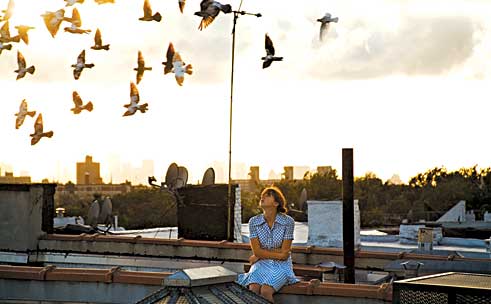
The most visually exhilarating scene occurs on a rooftop when Al takes Ivy to see his friend’s pigeon coop, where she finally breaks down, while pigeons swirl in formation overhead. The film is also book-ended by the trip from upstate to Brooklyn, where the moving landscape is reflected on Ivy’s sleeping face, and the return ride back, where Gray relies on the power of the camera to capture those subtle moments that are somehow beyond words.

The Exploding Girl, which is being distributed by Oscilloscope Laboratories, will be shown as part of the Wisconsin Film Festival in April.

Posted 19 February, 2010

Next Page »