
Me And You and Memento and Fargo


The Catechism Cataclysm

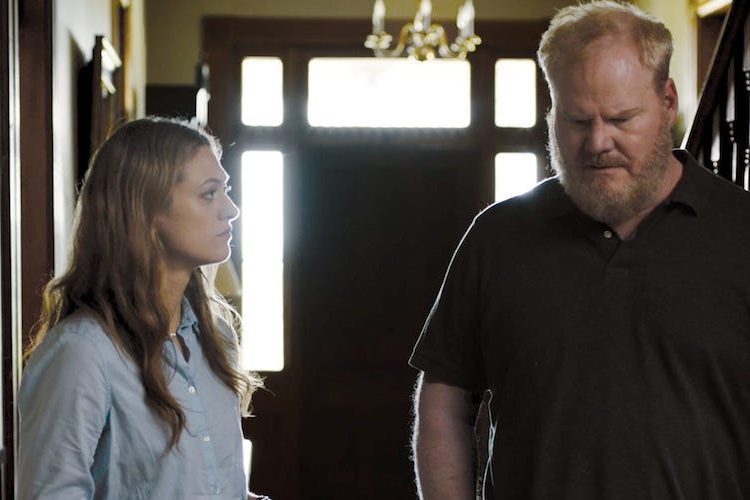
Todd Rohal’s richly inventive debut feature The Guatemalan Handshake (2006) was overlooked by the Sundance Film Festival at the time. In retrospect, this seems like an inexcusable oversight. Lacking a distribution deal after playing at Slamdance, Rohal took a single 35mm print on the road for two years. At the end of the journey, according to IndieWIRE, he reportedly buried the copy in the desert and burned the film’s promotional materials as a form of catharsis. Rohal’s new film The Catechism Cataclysm (2011) played at last year’s Sundance Film Festival, but, unfortunately, that’s no longer an assurance of a lucrative distribution deal. Yet The Catechism Cataclysm, which had a very brief theatrical run at the IFC Center in New York City, deserves a better fate. The film has also played VOD and will be released on DVD next month.

The Catechism Cataclysm reiterates Rohal’s gonzo approach to narrative. The new film very much takes aim at notions of storytelling. Father Billy (Steve Little) begins the film by telling a story to a Bible Study group about an elderly woman who mistakenly thinks her car is being stolen and pulls out a pistol, only to discover that she’s having a senior moment. Several of his parishioners are puzzled: What is the moral of the story? Father Billy claims such questions ruin it. When confronted by his superiors about his failure to make his sermons more pertinent to his congregation, he’s given a sabbatical to find himself. In response, Father Billy concocts a plan to renew his faith by embarking on a canoe trip with his old idol, Robbie (Robert Longstreet), whom he has badgered with endless emails after locating him on the Internet.

The Catechism Cataclysm tells the story of two contrasting characters: Father Billy, an immature and unhappy young priest, and his sister’s old boyfriend, Robbie Shoemaker. In high school, Robbie was a writer and death metal musician, whom the younger Billy worshiped, but his sister’s boyfriend, it turns out, doesn’t remember him. Father Billy mistakenly believes that Robbie is a musician in a major band, when, in fact, he’s merely a spotlight operator. That seems not to matter to Father Billy, who persists in his fantasies about Robbie’s super cool lifestyle. When he pesters Robbie for stories about his escapades, the roadie tells him about a couple of relationships that seem anything but romantic.

The Catechism Cataclysm takes the buddy film to its outer limits. It plays up the homoerotic nature of the genre by immediately having the two characters sit in adjoining bathroom stalls after eating greasy food at the diner where they initially meet. Father Billy, for instance, tests Robbie’s ability to detect the difference between simulated and real passing of gas. Father Billy’s bible, which he has been using as an autograph book, falls into the toilet after he takes a dump. The film’s obsession with bodily functions exploits a kind of juvenile male humor that seems perfectly appropriate to the buddy genre and male bonding.

When the two men rent canoes, they meet two female Japanese tourists, who are enacting their own fantasy of being Tom Sawyer (Koko Lanham) and Huck Finn (Miki Ann Maddox), along with their guide, a black man, of course, named Jim (Rico A. Comic). Leslie Fielder’s famous essay, “Come Back to the Raft Ag’in, Huck Honey!,” originally published in the Partisan Review, forever changed everyone’s perceptions of American literature by emphasizing the homoerotic strain in Twain’s classic novel, as well as establishing it as a major literary theme. Rohal also manages to insert references to John Steinbeck’s Of Mice and Men, connecting the controversies of that novella to his use of similar material in the film.

Stories within stories abound in The Catechism Cataclysm. When Father Billy insists that Robbie tell him another tale, he recites one about a Mexican worker named Miguel who gets trapped inside a concrete pillar support underneath a highway while pouring concrete. A Latina woman, Maria, finds him and they fall in love, even though they can communicate only through a very tiny air hole. Father Billy wants to know, “And then what?” When that’s all there is, he criticizes Robbie’s fable for not having an ending, and offers his own version, which includes Miguel getting such a huge erection that it smashes through the cement. “It’s not an amazing boner story,” Robbie chides the priest, who seems obsessed with penises and inadvertently makes eyes at Robbie. “Don’t wiggle your eyebrows like that,” the roadie tells Father Billy, “It’s a come on. Do you want to come on to me?”

As the canoe trip continues, more stories get told. Once Father Billy and Robbie get lost and then stuck on shore, they meet up again with the Japanese women and Jim, at which point The Catechism Cataclysm veers off in even stranger and unexpected directions. In a mind-bending twist, the film suddenly switches genres, with references to David Cronenberg’s Scanners (1981). There were a number of weird indie movies released this past year, including Michael Tully’s Septien and Calvin Reeder’s Lynchian-inspired The Oregonian. Ironically, both feature the actor Robert Longstreet, who had a breakthrough year as an actor by also appearing in Jeff Nichols’s Take Shelter. Longstreet’s inspired performance as Robbie, an aging hipster with unfulfilled dreams, is a big part of the charm of The Catechism Cataclysm, while Steve Little somehow manages to portray a case of stunted development and regression with uninhibited, almost giddy comic intensity.

According to an interview on Twitch, Rohal originally planned to shoot from an outline, but the actors wanted a full script, which he then wrote quickly. But, as usually happens these days, the script transformed in the process of shooting. Rohal explains: “Steve and Rob met the day before we started shooting. Steve’s been a member of the Groundlings for years and thinks incredibly quickly on his feet. I could simply give him a seedling of an idea and he’d run with it to some far-out places. And Rob is just totally natural in front of a camera. He’s the easiest man in the world to talk to, an actor who doesn’t stop thinking or creating for his character. He would riff on the script over the phone to me, I’d write down those ideas and integrate them into the next draft.”

Todd Rohal’s sheer fascination with the wonders of storytelling, disregard for conventions, irreverent sense of humor, and idiosyncratic penchant for the absurd shines through once again in The Catechism Cataclysm. The incongruous mix of religion and death metal makes for an intriguing character study, but it’s Rohal’s willingness to take narrative risks that ultimately makes the film such a pleasure to watch.


Posted 22 January, 2012

Terri

In Azazel Jacobs’s Momma’s Man, there’s a scene toward the end where the mother of the protagonist, Mikey, gets him to sit on her lap and he looks like an overgrown baby, dwarfing her in size. The image serves as an apt metaphor. He’s not a momma’s boy, but a grown man – stuck in a state of arrested development. Jacobs’s latest film, Terri, which played at last year’s Sundance Film Festival, features another social misfit, only this time, he’s not a young adult regressing back to high school, but an actual overgrown teenager named Terri (Jacob Wysocki), who wears pajamas to school. Unlike Mikey in Momma’s Man, Terri hasn’t been smothered to death by a doting mother. In fact, he doesn’t have parents – he claims not to know where they are – but lives with his Uncle James (Creed Bratton), who suffers from early Alzheimer’s disease. Although the arc of Jacobs’s career appears to be heading toward becoming more commercial, beneath the surface of this coming-of-age story, from a script by Patrick deWitt, lies something far more bizarre than first appears.

The film begins with a close-up shot of Terri slumped against bathroom tiles. There’s a knock on the door. His head moves, as we hear Uncle James badgering him about cleaning the “tub ring.” After the opening title credit, we see the overweight Terri – a huge mound of flabby flesh – soaking in the bathtub. He responds, “I can’t clean it because I’m still in here, okay?” Terri’s resigned and curt responses show a frustration with having to deal with an uncle who has trouble keeping the basics straight. For this teenager, roles are reversed – he’s forced to be the caretaker when he’s clearly struggling himself. At school, he’s perpetually late and the other kids harass him by discussing sexual acts with girls, much to his annoyance. Terri tries to remain invisible, but his inappropriate attire brings him to the attention of the assistant school principal, Mr. Fitzgerald (John C. Reilly), who delights in keeping track of the weirdos at his school.

Mr. Fitzgerald tells Terri he basically divides the kids into two groups – the good-hearted kids and the bad-hearted ones. When Terri asks which category he falls in, Fitzgerald suggests that he belongs in the good-hearted group, but then makes Terri come to see him every Monday morning. Mr. Fitzgerald is something else – an adult misfit in a position of authority. The most whacked-out student, Chad Markson (Bridger Zadina) – a pint-sized kid with the habit of pulling out his hair – is highly critical of Mr. Fitzgerald: “Half the time I think he wants to hit me; the other half, I’m scared he’s gonna kiss me or something.” When Chad goes into greater detail, Terri freaks out and abruptly kicks him out of his house.

Terri winds up befriending a female classmate, Heather Miles (Olivia Crocicchia), after she gets fingered by Dirty Zach in home economics class. When Mr. Fitzgerald is about to have her transferred to another school, Terri intervenes and the two teens strike up a friendship. When the ostracized Heather comes over to Terri’s house, Chad, uninvited, reenters the picture. This leads to an extended scene where the three of them get high off whiskey and pills. The loosening of inhibitions leads to painful and humiliating revelations that suddenly push the film beyond genre into what feels like uncharted territory. “It was not storyboarded,” Jacobs says of the scene in a Time Out Chicago interview. “I was able to get the kids to move around and start working together. I was on uncomfortable ground.… There was only one right thing to do—to [create] an atmosphere that showed realistically what these kids were willing to do.” The scene is riveting precisely because we’re never sure what might happen next, which is what makes adolescence such a fascinating phase in the process of growing up.

In Terri, all the characters manage to expose unflattering aspects of themselves. For all his goodness, Terri reveals a dark side when he becomes overzealous at catching mice in traps, causing Uncle James to tell him, “I didn’t even know you were capable of doing something so ugly.” When Terri tells Mr. Fitzgerald about the incident, he responds, “It’s blood lust, dude. It’s a hard habit to stop once you get started in on it.” Terri, however, later becomes angry when he realizes that he’s been lumped in with the other “monsters” at school, which causes Fitzgerald to tell him a personal story about growing up, which merely proves to be a part of his motivational shtick.

Mr. Fitzgerald may, in fact, be the most confused person in the entire film. He is shown to be a liar, a guy who pretends to chew kids out for the benefit of his elderly, dying secretary. Fitzgerald is someone with his own marital problems. His interactions, fraternization, and unprofessional comments about the personal lives of his students and staff would most likely get him fired (if anyone happened to be paying attention). It’s no surprise when graffiti appears on the side of the school building, announcing “Fitzgerald is a Zombie.” At one point during a session with Terri, Fitzgerald puts his head in his hands on the desk and despairingly tells him: “You know sometimes I just think I should leave you kids on your own. The way these other kids treat you, maybe that’s preparation for the real world.”

Mr. Fitzgerald later confesses to Terri, “Life’s a mess, dude. But we’re all doing the best we can . . .  So if I hurt you or if I lie to you, all I can tell you is ‘I’m sorry.’ And I will try to do better. Maybe I will do better, or maybe I’ll do even worse. I don’t know. I screw up all the time. Because that’s what people do.” Jacobs’s tale of adolescence seems to suggest that, despite everything that happens, Terri does find some consolation. Mr. Fitzgerald may be a terrible role model on many levels, but Terri manages to learn from him, along with the other cast of misfits, including poor Chad.

Terri is not a tale of adolescent redemption. It resembles more honest films on the subject like Neal Jimenez and Tim Hunter’s River’s Edge or Antonio Campos’s Afterschool. Jacobs admits that he was more of a hardcore punk rocker in high school, which meant being “cowardly mean.” He told an interviewer at SXSW: “So, I don’t know, I’m not trying to make amends but it’s something that you think about as you get older . . . how you could have been nicer person.”


Posted 17 January, 2012

Bellflower

In Bob Byington’s comedy Harmony and Me (2010), Harmony (Justin Rice) complains to an acupuncturist about his ex-girlfriend, “She broke my heart, but she’s still at it. She hasn’t finished the job. She’s breaking my heart.” He continues, “My heart is a snack. She’s like a bear with a fish in its paw.” Evan Glodell’s wildly kinetic and completely engaging Bellflower (2011) deals with the same subject matter, the absolute pain and misery of a broken heart, but his version is inspired by the Mad Max movies that the film’s protagonist, Woodrow (played by Glodell himself), and his adoring Jughead-like best friend, Aiden (Tyler Dawson), saw on TV and then on VHS as kids in Wisconsin.

Bellflower begins with what first seems like a prolepsis and may, in fact, be a flashback: shots of a crying couple, various key scenes from the film playing in reverse, and finally a head-on shot of the film’s dazed protagonist before it cuts to black. There’s a quote that references The Road Warrior, “Lord Humungous cannot be defied.” In voiceover, we listen as Aiden lays out their fantasy for the end of the world. The two friends will turn up in a bad-ass, flamethrowing muscle car, “and one of us gets out with a hundred pounds of brass and steel strapped to our back, and just starts torching everything.”

Glodell’s apocalyptic Bellflower is a complex play on the thriller and buddy genres, with the dialogue between the two male characters loaded with sexual innuendo that they seem unaware of, but will cause most viewers to chuckle. Aiden compares Woodrow to Lord Humungus and tells him: “Okay, listen. We’re going out tonight. If I even catch you looking at someone – I don’t care if it’s a fucking guy. You are going to hit on them. You are going to pick them up. You are going to take them home. And I’m going to be right by your side the whole time.” For these dudes, true male camaraderie knows no bounds.

The story is told in chapters. In the first, “The Pursuit of Happiness,” after the two friends nearly finish assembling their flamethrower, they wind up in a bar where Woodrow gets into a cricket-eating contest with an attractive blonde named Milly (Jessie Wiseman). She trounces him at downing live insects, but he ends up asking her out on a date. The next evening, he politely shows up at her house with a small bouquet of hand-picked flowers. Because it’s their first date, Woodrow wants to take her to someplace nice, but she prefers that he take her to the “cheapest, nastiest, scariest place” he knows. “Oh, my God,” Woodrow responds disbelievingly, but Milly’s request sends them on a journey from Los Angeles to Texas. As they lie together in the back seat of a car and he giggles with delight at their blossoming romance, Millie warns Woodrow that she’ll hurt him. A true tough guy, he doesn’t believe it.

While Woodrow and Millie are away, Aiden hooks up with Milly’s best friend, Courtney (Rebekah Brandes). At her birthday party, when Aiden drunkenly insults a woman and a huge thug accosts him, Woodrow rushes to the aid of his friend and smashes a beer bottle over the guy’s head, forcing them to split. Woodrow and Milly make love later on, but when Woodrow tells her he’s leaving for a day, their blissful courtship comes to an abrupt and bitter end. This leads to intrigue and betrayals of all sorts, involving the four main characters in the film.

It’s not the plot of Bellflower that keeps us riveted, so much as the film’s visual pizzazz, its golden and fiery orange color palette, rhythmic pacing, comic antics, and the intricate way the love story is interwoven with Woodrow and Aiden’s adolescent quest to build a flamethrower and Medusa car in anticipation of the world’s imminent demise. Woodrow’s broken heart leads to a terrible car accident that leaves him temporarily incapacitated and then to a fury that turns Woodrow into a vengeful monster, who unleashes an inferno that’s been foreshadowed by Aiden’s initial voiceover.

Reportedly made on a shoestring budget, Bellflower was a surprise hit at last year’s Sundance Film Festival. It is an obvious labor of love by a collective group of friends (Coatwolf Productions), who dedicated themselves to making this incredibly ambitious project over an extended period of time – without the financial means and against impossible odds. Bellflower definitely calls to mind a number of filmic references, including Harmony Korine’s deliberate degradation of the image in Trash Humpers (2010). And listening to the film’s awkward naturalistic dialogue, it’s hard not to think of numerous mumblecore films:

MILLY: So, who are you, where are you from, what do you do?
WOODROW: Ah, wow! Okay . . . I live around here, but I’m from Wisconsin originally. And I spend . . .
She looks down at his shoes.
MILLY: Oh, my God!
WOODROW: What?
MILLY: Sorry. Your shoes.
Cut to a shot of his tattered sneakers.
WOODROW: Oh, yeah! I need to get new ones. They’re pretty bad . . .
MILLY: I’m sorry. I’m sorry. What do you do?
WOODROW: I’m building a flamethrower.
MILLY: You’re building a flamethrower?
WOODROW: Yes.
MILLY: Fuck you.
WOODROW: No, I really am, and I’m really excited about it.
MILLY: That is probably the weirdest thing I ever heard. I like you.
WOODROW: I like you too.

If the acting style is rooted in naturalism, the performances by Glodell, Tyler Dawson, Jessie Wiseman, and Rebekah Brandes transcend the style. Dawson, as Glodell’s impish sidekick, causes every scene he’s in to sparkle with his nutty brand of humor, while Wiseman and Brandes are perfect in their roles and would seem to have promising careers ahead of them. It’s hard to imagine how a low-budget DIY film like this could get better acting from a cast of unknown performers.

Not only did the filmmaker and his crew build an actual flamethrower, from parts culled from a hardware store, that shoots a burst of flame 72 feet, but they also spent a great deal of the budget on their flame-spewing Medusa car, which left P. Diddy so impressed he forked over a “grand” toward their project. And they adapted a digital camera with lenses that had dirt smeared on them, which gives Bellflower the antique quality it strives for.

Some people might try to dismiss Bellflower as merely a juvenile male fantasy, but the film deals with a substantive issue – the transformational power of love, and when it goes sour, its attendant dark side. I’m convinced the film provides its own self-critique. The bravado and macho fantasies of Woodrow and Aiden are a way of their overcompensating for their inadequacies. Early on in the bar, Milly insists that Aidan is “a little bit of a bastard,” but Woodrow, of course, defends him. He responds, “Aiden? No, he’s just crazy. Once you get to know him, he’s like the sweetest dude you’ll ever know.” “Sweet” is a word these dudes throw around with abandon, but they seem acutely aware that their fantasies are completely gendered.

As a narrative, Bellflower is far more complicated than it first appears. Two viewings have yet to answer all my questions, which involve its temporal shifts and multiple endings. It’s like Glodell is so in love with his film that he can’t seem to let it conclude. Even after the end of the world, Bellflower somehow manages to play on.

Posted 10 January, 2012

Northeast

Gregory Kohn’s debut feature Northeast (2011) explores Brooklyn as a hub for immigration by young people who drift there from other parts of the country. There is a sense that most relationships are transitory. Because most young folks are recent transplants, everyday social interactions have an inherent awkwardness about them that stems from people not really knowing each other very well. “I’m sorry, I totally forgot your name,” Will tells a guy named Mark early on, but it turns out Mark can’t remember his name either. Parties, such as the one we view, are a mob of strangers rather than a communal gathering. The attendees might as well be at a local night club. Given the current state of the economy, career dreams have faded for this age group, resulting in anomie and alienation. In this regard, Northeast manages to capture the texture of life for this millennial generation in a profound way.

Northeast focuses on Will (David Call from Tiny Furniture), a character who has about as much affect as a serial killer. In fact, Catherine Goldschmidt’s camera frames him like a hustler through tight framing, as he hangs out on the streets of Brooklyn. He’s a guy who seems to be on the perpetual make, as he stands on corners or seems to be in a rush to go nowhere. Goldschmidt shoots a number of scenes in which Will is isolated in abstraction, such as against out-of-focus car lights, or when vehicles whiz by in from of him as blurs of color, as in my own Highway Landscape (1971-72). As he rides his bicycle through busy traffic in one stunning visual sequence, he continually shifts between figuration and abstraction. And the film’s final image, after Will leaves the frame, remains out of focus. In fact, one of the major strengths of Northeast is the inventive way it’s shot, including its grainy 16mm original format.

Not much happens in Northeast. We basically follow Will through a series of brief loveless affairs. His escapades do not seem so much like an obsession (as in the case of a sex addict), as a way for him to fill up the empty time in his life and avoid looking for a job. After sleeping with a woman named Leah (Megan Tusing), he stares at her in bed before his mind wanders away. He tells her he’ll call, but when she presumably calls him, he avoids answering his cellphone. At one point, Will buys a stolen bicycle for $60, even though it’s winter. This provides him with some distraction, as well as a means of transportation and seduction. He arrives unexpectedly at an old school chum’s door, and gets her to go bike riding with him. Despite the fact that he considers Lauren (Lauren Shannon) to be a bad housekeeper – she has roaches in her apartment and a filthy stove – he conveniently moves in with her when his roommate’s wife comes to town. The relationship, however, ends abruptly when she returns home from work. Why? The scene contains no dialogue and it’s never made clear, but perhaps she’s found out the real reason for his sudden attention to her.

Kohn buries the motivation of his characters. Will’s roommate Jason (Jason Selvig) is married, but what that’s about remains unclear. Will, in particular, is opaque and impenetrable and, hence, something of an enigma. We know virtually nothing about him. Although he’s constantly on the prowl, the intimacy of sex only seems to make him more restless. At one point, Will picks up an older woman named Caroline (Laura Ford) in a library. He cruises her in the book stacks with quick glances before approaching her by saying, “Excuse me, sorry, I don’t mean to be weird . . .” As she plays cards with Will and Jason afterwards, Jason asks her about her life. In college, Caroline studied art history and dreamed of running a gallery, but she’s now working in a “boring and useless job” in real estate because it pays the bills. Hanging out with two younger men, she’s made to feel self-conscious about her age, especially when Jason tactlessly asks her how many kids she has. After Caroline excuses herself, she explores her face in the bathroom mirror, and tries to smooth out the bags under her eyes. It’s a poignant moment in a film where emotions, for the most part, have become hardened. The next morning, Will watches from the window as she disappears down the street, never to be seen again.

Will earlier attempts to pick up a friend’s girlfriend named Molly (Eléonore Hendricks from Daddy Longlegs and Bad Fever). She turns him down for ignoring her earlier at the party, but he later borrows a car to visit her and her boyfriend, Patrick (Tate Ellington), in the country. As the three of them are outside exploring nature, at one point Will makes a calculated move toward Molly, but she quickly withdraws to the security of Patrick. Their relationship and retreat from the city provides a striking contrast to Will’s string of one-night stands in Brooklyn, so that the tree that’s tattooed on his arm suddenly takes on symbolic meaning. There’s something very pathetic, even scary about Will, whom the film views with icy detachment.

The formal qualities of Northeast are what allow the film to transcend its episodic naturalism. Many scenes climax abruptly, leaving gaps in the narrative. The vacuous dialogue, which struck me as a form of anti-dialogue, is deliberate on Kohn’s part. And the film’s utter lack of music to create emotional resonance for the characters seems a perfect aesthetic decision. Kohn told an interviewer: “There’s not a line of dialogue in the movie that means anything at all. I can’t stress that enough. . . I’d rather show that there is tension and conflict in the subtext. You have to search for it, and I didn’t want to provide music that would clue the audience into that; I want the audience to have to work.” That is certainly a noble ambition, which, in this case, provides rich rewards.

Kohn’s Northeast, which is being released by Tribeca Film, is currently playing on VOD.

Posted 2 January, 2012

Green

Sophia Takal’s Green delves into the lives of a young urban intellectual couple from New York. Sebastian (Lawrence Michael Levine) and his girlfriend, Genevieve (Kate Lynn Sheil), retreat into the country, presumably somewhere down south, for an extended period. Sebastian is a writer, whose project is improbably about sustainable farming, while Genevieve has tagged along to be with him. Fissures begin to appear in their relationship, especially when a neighbor, Robin (played by Takal), in her own naïve way, exacerbates the hidden tensions between them. Interviews with the director suggest that the film is about female jealousy, but, for me, Green also explores class difference, which, as we all know, has recently developed into class warfare. Given the current polarized political climate in this country, this is precisely what makes Takal’s film resonate so deeply.

We get a sense of Sebastian and Genevieve’s relationship in the pre-credit sequence when they sit around with peers (Alex Ross Perry, the director of The Color Wheel, and Dustin Guy Defa, the director of Bad Fever, among others) and compare Philip Roth to Proust. Although it occurs early on, so that we don’t yet have a grasp of the characters, Sebastian puts down Genevieve’s difference of opinion by suggesting that she only read the first 30 pages of Roth’s novel When She Was Good. She claims otherwise. In defending his love of Roth, Sebastian drapes his arm around her, winks to the others, and smugly tells them, “I’ve read a little bit more.” This cuts to a wide shot of two lawn chairs on the bottom left of the frame of a rural landscape, as their car pulls up and they begin to unpack.

As Sebastian writes, Genevieve quickly becomes bored by life in the country. Suddenly left on their own, the two are revealed to be utter strangers, whose hip intellectual snobbery is the only glue that holds their fragile relationship together. Once Robin shows up – they initially find her asleep on their front lawn – she becomes an easy target for their ridicule. A southern working-class country bumpkin, she intrudes upon their lives, without quite realizing that she’s the object of their scorn (as well as their desires). Early on, Robin comes over with some groceries and a magazine. When Robin asks Genevieve what she’s reading, she answers, “Georges Bataille.” The clueless Robin responds, “Oh, cool.”

Sebastian and Genevieve’s stint in the country begins to feel like a regression into ’60s nostalgia, especially when Sebastian begins to wear a headband. But the hippie idyll has its dark side. In one telling scene a good forty minutes into the film, Genevieve and Sebastian make love. Her refusal to play along with his sexual fantasy exposes a deep personal rift between them and appears to trigger what follows. Green may take its sweet time to get going, but once it does, it moves with the swiftness of a natural disaster. As Green continues to unfold, Genevieve gradually bonds with Robin, before beginning to unravel. She views her relationship with the older Sebastian with a sense of disdain mixed with extreme insecurity, especially when she starts to imagine him being sexually involved with Robin.

Genevieve wants to go back for an art show, which has gotten a good review in Artforum, but Sebastian pontificates: “Honey, I knew this guy at Dalton. Okay? He couldn’t even string a complete sentence together; no less create a coherent piece of art.” As Genevieve shakes her head in disagreement, Sebastian insists, “He basically fills a room with junk and then a group of moronic quasi-intellectuals come in, mentally masturbate, and decide it actually has some meaning to it.” As he tries to explain installation art to Robin, Genevieve becomes openly rude to her. When Robin unexpectedly shows up with a date one night, Genevieve finally loses it. In a field, the film reaches an ambiguous climax, but the film’s resolution is cruel enough to spark a class uprising.

Shot in a mere two weeks, Takal’s directorial debut won a prize at SXSW and has been playing the festival circuit. Some scenes were initially improvised and then later scripted – a technique that’s being used more and more these days. Takal is not interested in naturalism, but what lies beneath its surface. In an interview in Hammer to Nail, she commented: “I think mumblecore movies are really honest and natural, but I wanted to use the medium to explore someone’s psychology, and what was going on inside of [Genevieve]. That was important to me. So I definitely did want to step away from handheld naturalism.”

Takal, who has a budding career as an actress, conveys such genuine sincerity as Robin that she exposes the mean-spirited flaws of the other two characters every time she opens her mouth. A psychodrama with overtones of the horror genre, Sophia Takal’s Green has the feel of a sharp spike rammed into an unsuspecting heart.

Posted 12 December, 2011

Martha Marcy May Marlene

The fragility of the human psyche seems especially pertinent at this particular moment, as evidenced by recent zeitgeist films such as Jeff Nichols’s Take Shelter and Miranda July’s The Future. Sean Durkin suggests in an interview: “I guess I’m most afraid of conforming. Groups that conform in a blind way without understanding what’s happening to them, that terrifies me. That was a major fear of mine as a child.” Perhaps it shouldn’t surprise us then that fear permeates his debut feature Martha Marcy May Marlene, a riveting character study of a young cult victim, which might be the most disturbing film I’ve seen this year.

Martha Marcy May Marlene begins with scenes of a rural commune, in which dinner is segregated by gender – not surprisingly, the men eat first. While everyone is sleeping, a young woman named Martha (Elizabeth Olsen), who has been renamed Marcy May, suddenly bolts into the thick woods. A male voice calls out, “Marcy May, where are you going?” As she runs frantically, others soon follow in pursuit. At a small-town diner, she appears paranoid as she makes furtive glances and wolfs down her food. Sure enough, she is confronted by another member, Watts (Brady Corbet), who has tracked her down. Martha manages to use a payphone to call her sister, who begs her to come home. We feel relieved when she’s rescued from the Catskills and transported to her older sister’s lakeside retreat in Connecticut. Once there, she learns that Lucy (Sarah Paulson) has recently married a developer named Ted (Hugh Dancy).

When quizzed about her whereabouts – it turns out she’s been missing for two years – Martha offers a vague story about a boyfriend with whom she’s broken up. If something seems “off” about Martha’s responses, the same could be said about Lucy’s. Claiming to feel guilty, she has accepted her sister’s disappearance with an odd sense of nonchalance. “Get a good night’s sleep,” she tells Martha, “and you’ll be as good as new tomorrow.” Lucy, who’s clearly in denial, tells Ted, “She seems okay.” Whereas Curtis in Take Shelter is tormented by images from the future, Martha is haunted by memories from her past. Signs that things are not okay become obvious when she begins to talk and act inappropriately. The first comes when Martha impulsively strips off her clothes and goes skinny-dipping in the lake in front of Ted. She also wonders why their house is so big, and blurts out, “Is it true that married people don’t fuck?”

The film uses a parallel structure in shifting between the present and Martha’s past life in the commune, which is slowly revealed to be a bizarre cult, run by a skinny Charles Manson-like figure named Patrick (John Hawkes), who has sex with all the young women. Shortly after he initiates Martha, she falls under his spell after he sings a song about her in front of the others. Whether it’s the result of the juxtaposition of scenes, there seems to be a sexual undercurrent between Martha and Ted as well. When Lucy goes into New York City, the two are left together. There’s something about the way he slips behind her in showing her how to navigate a speedboat that feels smarmy. The two also drink beer together afterward. When he confides that he and Lucy are trying to have a baby, Martha bursts out laughing. She tells him dismissively, “I can’t imagine Lucy holding a baby. She wouldn’t know what to do with it.”

In a flashback, we watch Martha slip into bed with Patrick during the middle of the night. Right after this, she gets into bed with Lucy and Ted while they’re in the heat of making love. Lucy insists that there are defined boundaries. Flustered, she explains to her, “It’s private.” She gets Martha to admit that what she did was wrong “because it’s private and not normal.” As a result of the intrusion, Ted is forced to spend the night on the sofa. In the morning, Lucy thanks him for his patience, but he flat out tells her that her younger sister’s behavior is “fucking insane.” Martha talks about being confused about the difference between memories and dreams. When she acts as if this is natural, Lucy suddenly asks, “Do you blame me?” Martha insists, “I’m a teacher and a leader and I know who I am.” Lucy answers, “What are you talking about?”

When Ted questions Martha about her career plans, she asserts that there are other ways to live. She tells him, “People don’t need careers. People should just exist.” She has an ideological defense for her lack of ambition and becomes more vocal in her criticisms of her sister and husband, who define success in terms of money and possessions. After Ted chews her out for being a freeloader, Martha explodes: “You don’t know anything about it.” The temporal shifts between past and present become more revealing as the film progresses. If we question how Patrick holds power over his followers, there’s a key scene where he teaches Marcy May to shoot a gun in the forest. “Think of someone who has hurt you,” he tells her, as she aims her weapon. The tension increases as Patrick’s sociopathic nature suddenly becomes manifest.

The members of the commune, who eat a single meal a day, talk about creating a sustainable farm, but in the interim Patrick has them hit up their parents for money and also break into lavish houses to get what they need. There’s a scene in which Lucy gives Martha a makeover before a party, which seems to reference Bergman’s Persona, but Martha has a meltdown during it. When Lucy tells her that they want to have a family and she can’t stay with them any longer, Martha tells her: “Lucy, you’re going to be a terrible mother.” Lucy and Ted’s decision about Martha sends the film toward what feels like an inevitable conclusion.

Sean Durkin was part of the team that created Antonio Campos’s Afterschool (2008). Durkin gets a terrific performance from Elizabeth Olsen in her acting debut. Her face exhibits an inscrutable innocence that also harbors deep pain and unfathomable secrets. In short, she captures the schizoid nature of Martha, whose fractured identity is reflected in the title of the film and her three different names. Martha Marcy May Marlene is a psychological thriller, with overtones of the horror genre. The latter reaction seemed to surprise Durkin, who deservedly won the Best Director award at last year’s Sundance Film Festival. Maybe the sense of horror we feel in Take Shelter and Martha Marcy May Marlene merely reflects the sense of the abnormal that has become a part of our everyday lives. It’s little wonder that the genre is having a big resurgence.

Posted 13 November, 2011

Words & Images: Screenwriting Conference

For the past several years, I’ve presented papers at the annual conference of the International Screenwriting Network. It’s an exciting event, and one I look forward to each year. Noted film scholar David Bordwell gave a keynote address at the recent conference in Brussels this past September, which also featured Jean-Claude Carrière. On his popular blog, Observations on film art, which he maintains with Kristin Thompson, David wrote two lengthy entries about the conference. The first was about the conference talks and career of  the great screenwriter Jean-Claude Carrière, while the second, entitled “Scriptography” focused on other presentations at the conference.

Here is a “call for papers” and information about next year’s conference:

Call for Papers

Words & Images: Screenwriting Research

5th Screenwriting Research Network International Conference

September 14th-16th, 2012

Macquarie University, Sydney, Australia

This is a call for papers for the annual international conference on screenwriting research, this year organised by the Department of Media, Music, Communication & Cultural Studies at Macquarie University. The Screenwriting Research Network is a research group that commenced in 2006 within the Louis Le Prince Research Centre, at the Institute of Communication Studies (ICS), University of Leeds. The network has achieved a critical mass in recent years with conferences taking place in Leeds (2008), Helsinki (2009), Copenhagen (2010) and Brussels (2011). The fifth conference widens the geographic spread of the network to the Asia-Pacific, taking place in Sydney, Australia (2012).

The international Screenwriting Research Network is comprised of scholars, writers  and practice-based researchers devoted to rethinking the screenplay in relation to its histories, theories, values and creative practices. The aim of the conference is to continue, and expand, discussions around the screenplay and to strengthen a rapidly emerging, and global, research network. The Journal of Screenwriting, since 2009, stands testament to the vitality of the screenwriting network across traditional and practice-based research. This is in addition to growth in publication of screenwriting monographs by scholars in the network, for example screenwriting books by Stephen Price, Steven Maras, JJ Murphy and Jill Nelmes to name a few.

The key theme of the conference is ‘Words & Images’. This speaks to the complex, intertwined, and ephemeral relationships between words and images that screenwriters negotiate.  Alain Robbe-Grillet claimed  ‘conceiving of a screen story would mean already conceiving of it in images’ (1961). While Gary Davis suggested that a screenplay is a ‘story told with word-pictures’ (Price: 2010).   In the age of media convergence, screenwriting forms and practices intersect, in new and unpredictable ways, with other forms that unite words and images:  the graphic novel, the comic, illustration, the graphic essay, visual arts and interactive media.

Confirmed keynote speakers will be confirmed in the new year, 2012.

We would like to invite abstracts for research presentations on (but not limited to) the following topics:

  • The history of screenwriting around the globe
  • Screenwriting archival research
  • Theorising screenwriting and the screenplay
  • Reflections on narrative theory and dramaturgy
  • Pedagogy of screenwriting
  • Practice-based research
  • Process-based investigations of creative screenwriting
  • Scripting and digital scripting processes
  • Screenwriting as research
  • Authorship frameworks in screenwriting
  • Screen adaptation and the nexus of adaptation studies and screenwriting
  • The question of the auteur in screenwriting
  • Case studies on individual writers or texts
  • Collaborative modes of writing for the screen
  • Screenwriting manifestos
  • Screenwriting for Independent cinema
  • Cinematic writing
  • Questions of intermediality in the digital age
  • Cross-fertilisation between screenwriting and other media
  • Screenwriting for interactive and online media (games, webisodes)
  • Transmedial screenwriting
  • The role of writing in non-fiction film
  • Screenwriting for animation
  • Writing for episodic television: are we  experiencing a new ‘golden age’?
  • Genre-orientated considerations of screenwriting and the screenplay

Call for Papers

Time allotted to each paper is 20 minutes plus discussion. Abstracts (250-300 words) may be submitted until December 12, 2011.  Earlier submissions are welcome. Please remember to state your name, affiliation and contact information. Include a brief statement (100 words) detailing your publications and/or screenwriting practice.

Please send your abstract to Alex Munt: alex.munt@mq.edu.au

More information on the program as well as cost, travelling and accommodation details will be available on the conference website at http://www.mmccs.mq.edu.au/wordsandimages

The conference is supported by the Faculty of Arts at Macquarie University, Sydney and is organised with assistance from the Screenwriting Research Network.

For further information, please contact Kathryn Millard, kathryn.millard@mq.edu.au or
Alex Munt, alex.munt@mq.edu.au at the Department of Media, Music, Communication and Cultural Studies, Macquarie University.

Conference Co-Directors:

Professor Kathryn Millard, Department of Media, Music, Communication and Cultural Studies, Faculty of Arts, Macquarie University

Dr Alex Munt, Department of Media, Music, Communication and Cultural Studies, Faculty of Arts, Macquarie University

Posted 7 November, 2011

The Future

The idea that things in the world are not quite right seems to be pervasive these days. Economic recessions and global crises will do that, but something much deeper appears to be at work. Jeff Nichols’s new film Take Shelter takes most people’s anxieties about health insurance, job loss, and climate change and turns them into a powerful apocalyptic drama about an Ohio construction worker named Curtis, who’s either clairvoyant or going bonkers. Nichols explained the genesis of the film in an interview in indieWIRE: “Bush was in the White House, the economy was collapsing, there were wars everywhere, towns were getting destroyed by storms. It was just like, what’s going on? It felt like the world at large was losing its grasp of keeping everything together. That was just in the air.” Take Shelter, which features a heart-wrenching performance by Michael Shannon, is a conventional genre film in many respects. Miranda July’s The Future deals with similar subject matter – those same anxieties about the future we all carry around with us while we navigate our daily lives. July’s enchanting new film presents the unconventional version, but it’s equally dark and disturbing.

As should come as no surprise to Miranda July fans, The Future is weird in highly imaginative ways. For one thing, it begins with a voice-over narration by a cat named Paw Paw, whose raspy voice is unmistakably July’s. “Have you ever been outside . . . never been inside . . . Then you know about the darkness that is inappropriate to talk about,” the cat tells us knowingly. Paw Paw, whose life outside has been a nightmare, is about to be put to sleep, but gets a reprieve when his rescuers, a couple named Sophie (Miranda July) and Jason (Hamish Linklater), agree to adopt him. In their mid-thirties, these two people live inside, but rarely go outside. When we first meet them, they lie on the sofa with their Apple laptops, too lethargic even to move. Like Dasha Shishkin’s painting Glory of Choice (which was part of her May show at Zach Feuer Gallery in Chelsea), the outside world is full of threats. Jason is a computer tech specialist, who works from home. Sophie teaches dance (which might more accurately be described as “hopping”) to young kids.

When Jason and Sophie, in an intimate moment, suggest, “I think we’re ready,” we think they’re referring to sex or trying to get pregnant, but they’re actually discussing adopting Paw Paw, who, due to renal failure, has only six months to live. The two of them reason that it’s not too big a commitment – they’ll be able to go on with their normal lives afterward. At the animal shelter, Jason views a drawing of a young girl holding a cat. The subject, Gabriella (Isabella Acres), is disappointed that her dad’s drawing hasn’t sold in the fundraiser, and asks him bluntly: “Do you want to buy it?” Jason buys the drawing, but Gabby has included her separated parents’ phone numbers on the back should he want to return it. Paw Paw is excited that the nice couple has returned and, after they pet him, he accidentally purrs. In cat terms, he understands the implications – he now belongs to them – admitting a feeling that would be “unwise to feel outside.” But, due to his injuries, Paw Paw must stay at the shelter for the next month.

Sophie and Jason end up adrift as a result of the unexpected delay in adoption. As they ponder their lives, the fact that they are five years from being forty creates a panic, because, after fifty, they consider the remaining years to be nothing more than “loose change.” As they discuss their aspirations, they feel an acute lack of achievement. Jason laments the fact he’s not richer or smarter or a world leader, while Sophie wishes she followed the news more closely. Sadly, they conclude: “It’s too late for us.” Facing an early mid-life crisis, they two try to re-prioritize their lives by imagining that they have only a month to live. They immediately quit their jobs. Despite an aversion to the outdoors, Jason canvases for the environmental group “Tree by Tree,” while Sophie decides to do a YouTube dance piece every day for 30 days. She also takes the drastic step of cutting their connection to the Internet, which they hope will make them more alert to what’s happening in the world. Sophie, however, soon becomes frustrated and restless. She obsessively calls Marshall (David Warshofsky), who made the drawing of Gabby and the cat, and the two begin an affair.

The Future is based on oppositions: inside/outside and tame/wild, in which Sophie becomes equated with Paw Paw. When she comes home, she tells Jason, “I’m wild,” which mirrors Paw Paw’s confession that he is theirs by day, but wild and alone at night. As Sophie tries to confess her affair to Jason, he frantically tries to stop time, a long scene in which he talks to the moon. The moon speaks in the voice of an elderly man named Joe (Joe Putterlik), who earlier sold him a reconditioned hair dryer. Yet Jason’s stopping of time winds up having disastrous consequences.

Like July’s previous feature Me and You and Everyone We Know (2005), The Future presents a world where human beings are subject to irrational forces beyond their control. In fact, Jason’s efforts to stop time in order to spare himself the pain of losing Sophie only make matters worse. In July’s world, children, like Gabby, have the power to manipulate adults (she orders Sophie to act naturally and wave to her father), and time is anything but linear. There are other quirks: a cat narrates the story from beyond the grave, an old man writes dirty limericks to his wife, Gabby buries herself neck-deep in the ground at night, two pregnant women’s children keep aging until they replace their parents who have died, the moon talks, and a yellow shirt becomes animate and grows to the point where July climbs into it to perform a strange womb-like dance. And what other feature would overtly reference Andy Warhol’s Sleep (1963)?

As he’s canvassing for his environmental cause, Jason addresses the sad state of the world. He tells a stranger: “It’s probably too late.” He compares the situation to a cartoon where a building gets hit with a wrecking ball. “We’re in that moment,” he contends, when the wrecking ball has already hit and everything is about to fall down. The Future captures the texture of what it feels like to be alive at a time when we all sense that the world might be on the verge of collapse, and how that affects us on an emotional level. Jason’s personal loss at Sophie’s betrayal is made all the more poignant by the sad fate of Paw Paw and his naïve but profound narration – his enduring love for these two messed up humans, until the moment when he confronts the void. “It’s just light,” he says, “and it goes on and on and on.”

Posted 30 October, 2011

Bad Fever

Dustin Guy Defa’s debut feature Bad Fever, set in the director’s home town of Salt Lake City, presents a fascinating study of contrasting characters: Eddie, a lonely misfit living under the thumb of his mother, and Irene (Eléanore Hendricks), a harsh street hustler, with whom he gets involved.

Eddie is a wannabe stand-up comic, who’s not the least bit funny. It’s a role perfectly suited to Harmony Korine, but Defa cast mumblecore director Kentucker Audley in the part. The choice proves oddly intriguing because Audley, who directed and acted in Team Picture (2007) and Open Five (2010), has been a strident advocate of naturalistic acting based on a performer’s own life. For him to play such a stylized role is clearly out of character. The irony in turns out to be the fact that Audley is often improvising, whereas Hendricks appears to be working closer to the page. Both are credited with providing “additional material” to the film’s script.

Bad Fever begins with a closeup of Irene making a phone call. When there’s no answer, she strolls over and stands in front of a convenience store. As someone approaches, she asks the person to buy her a pack of cigarettes. Irene seems desperate, as she circles around nervously. She opens the door and yells, “Marlboro Lights!” Eddie, a young man with long hair and a blue cap pulled down, as if he’s trying to appear invisible, exits and hands her the pack. He gets in his car and drives off, as she lights a cigarette in the background.

They come together roughly ten minutes later when Eddie picks up Irene while driving through the city one night. She tells him, “Maybe you can buy me something to eat or something like that.” She asks Eddie, “Are you hungry? Do you want to get something to eat with me? You want to share a plate of food with me? You want to get a milkshake together? Do you want to get two straws in a milkshake?” Even poor Eddie surmises that Irene is coming on to him.

At a restaurant, Eddie asks Irene, “Do you have a boyfriend?” The awkwardness of their conversation is a bit unnerving – like watching a spider spin a web to ensnare a naive and unsuspecting victim. That becomes clear later when Irene begins to film herself in the back seat of Eddie’s car with an antiquated video camera. When he inquires what she’s doing, she mentions making videotapes for a guy in Idaho Falls she met on the Internet. We begin to wonder, but Irene assures Eddie, “I don’t do anything sexual, all right?” But when Eddie watches her VHS tape at home later on, the sexual connotations of her eating a bowl of cereal are unmistakable.

The next day, Irene takes Eddie to an abandoned schoolhouse. As the camera is running, she asks seductively, “Do you like me?” After a pregnant pause, he answers, “Yeah, I think I do.” She asks him to take off his jacket. He wants her to turn off the video camera, but she insists, “No, that should stay on.” She takes his hand and begins to suck on his index finger. Irene orders him to lie down and take off his clothes. She becomes more abusive and barks, “Are you fucking deaf and dumb? Take off your fucking shirt!” She pulls off his pants and tells him, “Take off your underwear, you stupid bitch!” When he freaks out, she calls him a “pussy.” In leaving, Eddie apologizes, but insists that videotaping him sexually isn’t terribly romantic.

Even though Eddie is flustered by what’s happened, he’s smitten with Irene. He decides she’s someone he’d like his mother to meet, along with his imaginary comedy club fans. Eddie puts on a sports coat and tracks her down. Back at the abandoned school, Irene spray paints “dick” under a lewd drawing she makes of one. She then begins to direct Eddie in a home video and quickly turns into a dominatrix by making him pretend to have sex with a pink mop. Dressed in Eddie’s clothes, she then forces him to participate in a mind-boggling gender reversal that is so humiliating it’s truly painful to watch – not unlike what occurs to another social outcast, Keith Sontag (Dore Mann), in Ronald Bronstein’s Frownland (2008). This unlikely romance follows its inevitable trajectory, which is to suggest that more humiliation awaits poor Eddie.

Defa, who’s been making film since he was a kid, has an incredibly strong visual sense that feels effortless. There are some wonderfully subtle shots, such as when golden light reflects intermittently off the back of Eddie’s head as the camera follows behind him. Shots of railroad yards and deserted city streets at night suggest the desolation of an alien planet, which is reinforced by the sound of howling wind. The pacing of the film, which Defa attributes to his editor, David Lowery, who reshaped the structure of the film, is pitch-perfect. Yet, because Bad Fever is essentially a character study, the film succeeds largely due to the riveting performances of Audley and Hendricks (along with Annette Wright as Eddie’s mom and Allison Baar as Yoko in small roles).

Having seen Audley in his own films, what he’s doing performance-wise in Bad Fever feels incredibly risky, especially his use of idiosyncratic speech patterns and willingness to engage in embarrassingly unfunny comic skits. Hendricks, who appeared as the lead in Josh Safdie’s The Pleasure of Being Robbed (2008) and in Josh and Benny Safdie’s Daddy Longlegs (2010), proves terrific once again – a master at rolling her eyes. She manages to convey the pathology of Irene’s character through very small gestures, such as the way she holds and then carries a gray and white cat. Irene has adopted a hard edge as a means of survival – a defense mechanism that Eddie sadly lacks. But, even more importantly, Irene appears well-versed in feminist film theory. She clearly grasps the gendered dynamic of cameras and power, especially how to undercut the visual pleasure of the male gaze.

Bad Fever premiered at SXSW in March. The film is playing as part of a series, “Inside Jokes,” programmed by Mike King, at the UW Cinematheque. Defa’s film will have its Madison premiere on Thursday, July 28 at 7 PM. Local fans of indie cinema should not miss the opportunity to see it. The Brooklyn-based filmmaker will be in attendance.

Posted 9 July, 2011

Putty Hill

After financing fell through on a scripted feature about teenage metal heads in Baltimore, entitled Metal Gods, Matthew Porterfield put together a five-page treatment based on people and locations he discovered while developing it. Shot guerrilla-style in 12 days, the result turned out to be Putty Hill. Porterfield’s semi-improvised second feature mixes a simple fictional premise – the overdose of a twenty-four-year-old drug addict named Cory – with documentary elements, such as direct interviews. Porterfield uses Cory’s death to explore reactions of relatives and friends within a working class neighborhood of Putty Hill on the outskirts of Baltimore. In the process, he captures a sense of dysfunction and alienation that rivals that found in Chris Fuller’s dark vision of his home town of St. Petersburg Florida, Loren Cass (2009), or Harmony Korine’s celebration of white trash culture, Gummo (1997).

Porterfield’s impressive first film, Hamilton (2006), about an unwed teenage mother and the baby’s father set in Baltimore, screened at a number of film festivals and independent showcases, including the Wisconsin Film Festival (which is where I saw it), before seeming to fade away. Putty Hill shares the same formal rigor of Hamilton. It consists of a series of loosely connected scenes that occur the day prior to Cory’s funeral, as well as one shot in his pad afterward. The film is less a portrait of Cory (whose photo we finally glimpse at the wake) than of the people who knew him and the places he inhabited. Only gradually does his younger cousin, Jenny (Sky Ferreira, the film’s only professional actress), emerge as the central character of this group portrait.

Although she wasn’t really close to Cory, Jenny returns from Santa Monica, California for the funeral. Earlier, her father Spike (Charles Sauers), a local tattoo artist, discusses his nephew’s death and his own troubled past with an ex-con buddy of Cory’s named Dustin. In a long interview in which she rides in a taxi cab, Jenny, like Clarissa from River’s Edge (1987), worries about not being able to cry at the funeral, but reveals sad details about her conflicted relationship with her dad. Later that night, she breaks down after watching him apply a tattoo in the dark as he and three black men do drugs. As she weeps uncontrollably on the porch, he claims not to understand her behavior.

In a sense, Spike’s bewilderment epitomizes the detachment that these characters seem to experience in the face of everyday life. None of them can really fathom Cory’s death. They know it’s a tragedy, but are incapable of mustering any semblance of emotional loss. As human beings, they’ve become deadened by alcohol and drugs, or distracted by paintball skirmishes, tattoos, BMX bikes and skateboard parks. All of them seem to live with their mothers – their fathers are conspicuously absent from their lives. After Dustin’s brother, Cody, returns from skateboarding, his mom sits at the kitchen table with his black girlfriend and baby. She strums a guitar and sings a song for him (about “looking for your brain”), but he stirs his coffee loudly and rudely leaves to go to the bathroom. And the assembled group at Cory’s funeral can’t even let his mother, Cathy, deliver her eulogy without creating loud distractions that nearly drown out her words.

The funeral wake turns into a bizarre event. It’s held in a karaoke bar, where folks drink pitchers of beer. Someone does an off-key version of “Amazing Grace” (a last-minute replacement for the Rolling Stones’ song “Wild Horses” that created copyright problems), but it soon lapses into empty testimonials and spirited dancing that might seem more suited to a wedding. Cory’s grandmother, Virginia, who resides in a retirement home and smokes cigarettes, refuses to attend. She prefers denial to having to grapple with her feelings. If some of this at times contains an undercurrent of humor, it’s because Porterfield so clearly understands and appreciates the nuances of this subculture and has been able to nail the milieu so accurately.

Porterfield’s poetic sensibility is reflected in the film’s stunning shot compositions. His scenes unfold at a languid pace, but each is a feast for the eye, as well as the ear. Jeremy Saulnier, who, like Porterfield, attended NYU film school, has to be one of the most gifted indie cinematographers. In Putty Hill, he uses a dark muted palette and as little light as possible, so that you can’t help but be reminded of the work of Gordon Willis. One of the strongest scenes in the film is one of Spike giving a tattoo by flashlight. And the final one where Cory’s sister, Zoe, and Jenny visit his deserted apartment contains so little light we can’t really make out the identities of the two young women for sure. The scene, however, provides a fitting bookend to the film’s opening shots of Cory’s apartment, in which light creates reflections on the wall.

Porterfield’s staging of scenes is extremely imaginative in terms of image and sound. In an early scene in which Spike gives Dustin a tattoo, the buzz of the tattoo gun nearly drowns out the dialogue, so that Porterfield resorts to subtitles. In another early scene, four teenage girls hang out together on a couch. Two of them get up to have a cigarette.  The camera follows and frames them, but the remaining two offscreen are miked instead, causing a weird disjunction between what we’re hearing and seeing. When Zoe arrives in town for the funeral, she’s interviewed in front of a busy highway. In the night scene of the tattoo at Spike’s place, music drowns out the dialogue.

The director’s decision to use the documentary technique of interviewing the fictional characters is perhaps one of the most controversial aspects of Putty Hill. Who is the person asking the questions, and what is his relation to the narrative that is unfolding? Our local critic didn’t think it worked because he felt it created emotional distance from the characters. But with non-professional actors, who are not emotive to begin with, it tends to draw out the subjects, confusing the divide between subject and role in fascinating ways. Porterfield explains the strategy: “I guess I think about it as a disembodied voice – a voice coming from the camera – asking questions in the voice of the filmmaker, maybe the voice of the camera, but also the voice of the audience; but not as a physical body needing any reason to be there.”

Putty Hill provides additional proof of how digital cinema continues to transform indie film. It allows filmmakers such as Porterfield the liberty to shoot cheaply and quickly. In moving away from the written page, he’s been able to combine improvisation and visual storytelling as a means of providing a vitality that’s so often lacking in many conventional films today.

The film, which is being distributed by Cinema Guild, opened at the Sundance Cinemas Madison on Friday, two months after premiering in New York City. It will play for a week.

Posted 16 May, 2011

Next Page »