|
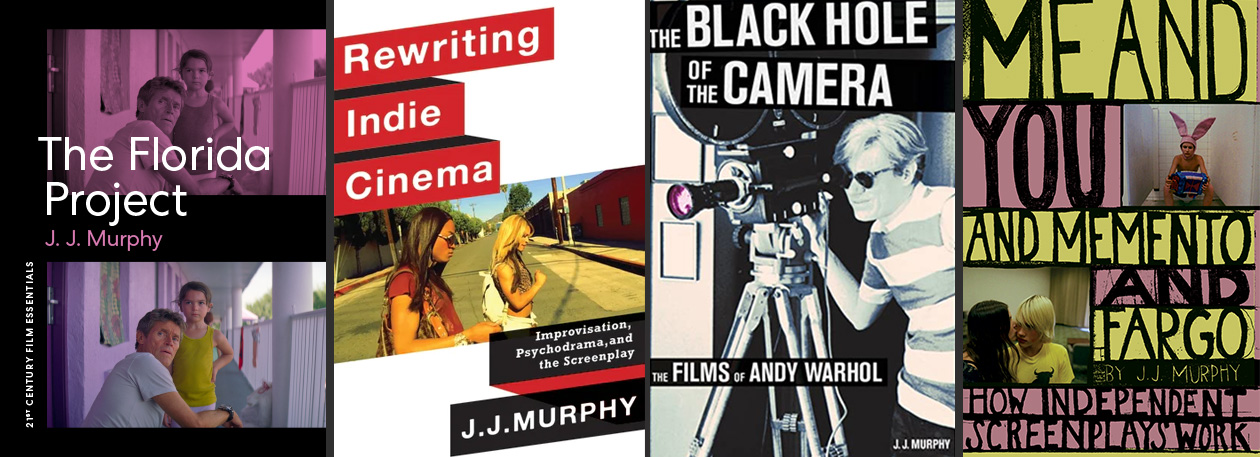
Andy Warhol, one of the twentieth century’s major visual artists, was a prolific filmmaker who made hundreds of films, many of them—Sleep, Empire, Blow Job, The Chelsea Girls, and Blue Movie—seminal but misunderstood contributions to the history of American cinema. In the first comprehensive study of Warhol’s films, J.J. Murphy provides a detailed survey and analysis. He discusses Warhol’s early films, sound portraits, involvement with multimedia (including The Velvet Underground), and sexploitation films, as well as the more commercial works he produced for Paul Morrissey in the late 1960s and early 1970s. Murphy’s close readings of the films illuminate Warhol’s brilliant collaborations with writers, performers, other artists, and filmmakers. The book further demonstrates how Warhol’s use of the camera transformed the events being filmed and how his own unique brand of psychodrama created dramatic tension within the works.
"J. J. Murphy has been researching and teaching the films of Andy Warhol for years, and today–literally, today–his monograph The Black Hole of the Camera: The Films of Andy Warhol comes out from the University of California Press. This is the most comprehensive, in-depth study of Warhol’s filmmaking that has ever been published, and of course a must-have for anyone interested in experimental film or the American art scene.
The ideas are fresh, especially the explorations of Warhol’s debt to psychodrama. At the same time, The Black Hole of the Camera clears away many misconceptions about Warhol (no, Sleep and Empire are not single-shot films) while also offering detailed information about and analysis of little-known stunners like Outer and Inner Space. There are several pages of color frames, which remind you that Warhol was as good at color as Tashlin was. JJ maintains a remarkable blog on independent cinema and is a leading figure in the Screenwriting Research Network."
— David Bordwell, Observations on film art,
(April 2012).
"Forget everything you think you know about Andy Warhol.
With the brilliant new book The Black Hole of the Camera: The Films of Andy Warhol, author J.J. Murphy obviously focuses in on the artist’s filmmaking career. However, Murphy may just be the first writer to integrate movies such as Couch, Eat, Empire, Lonesome Cowboys and The Chelsea Girls into the totality of Warhol’s artistic pursuits, i.e. silk screening, painting, filmmaking, videomaking, tape recording and photography.
This is, unbelievably, the first time in cinema scholarship such an endeavor has ever been undertaken. That may seem like a shame, particularly given Warhol’s enormous filmic output and his stature as one of the most important artists of the 20th century. Yet, it’s clear it’s been worth the wait for such an astute writer and Warhol film fan like Murphy to finally tackle the topic.
Previously, one of the problems with an in-depth analysis of most of Warhol’s films is that they were taken out of circulation almost immediately after they completed their screening runs. Therefore, most writing on them had to be based solely on—sometimes faulty—memories of those screenings and through generic descriptions of the films’ typically bland sounding set-ups, e.g. the film Haircut usually being described just as being about a man receiving a haircut.
Luckily, though, through recent preservation efforts, Murphy has been able to analyze Warhol’s prodigious film output directly, putting the lie to all previous conceptions about them. Reading through The Black Hole of the Camera, one will either be jealous of Murphy’s opportunity to study these films so closely or will consider him a candidate for sainthood for sitting through the entire eight hours of a single shot of the Empire State Building (Empire), five hours of a man sleeping (Sleep), a half-hour of a man eating a mushroom (Eat) and more.
Yet, by doing so, Murphy at last puts the lie to the long held assumption that to make these films Warhol simply turned on his camera and walked away until the last of the film roll passed through it. Just as he did with his book analyzing atypical screenplay structures, Me and You and Memento and Fargo: How Independent Screenplays Work, Murphy continues to prove to be extremely adept and insightful in zeroing in on a challenging film’s hidden nuances that reveal its true intention at audience interaction.
When he was alive, Warhol constantly strove to misdirect his audience’s perception of his work, particularly by claiming that everything he did existed completely on a surface visual level and that there was no depth to anything he did, which is, of course, total bullshit. Warhol’s greatest artistic achievement is perhaps what could be considered the lifelong performance art piece of never publicly cracking the image that he was nothing more than a superficial visualist. Not once during his entire career did he ever break down and confess to—nor even hint at—what all of his pursuits might actually mean taken as a whole.
Therefore his dabbling in different mediums is usually treated separately by those who analyze his work as if none of it is connected. Also, when it comes specifically to Warhol’s filmmaking career, it is typically analyzed as separate and disconnected periods. First, there are his static, pre-structuralist conceptual films such as Empire and Eat. Then, there’s his psychodrama period, such as his only semi-mainstream hit The Chelsea Girls. Then, there’s his sexploitation films, such as Lonesome Cowboys. And, lastly, there are the Warhol 'produced' and Paul Morrisey directed films like Trash and Heat.
However, Murphy very successfully argues that there was a very deliberate evolution to Warhol’s filmmaking styles that can be discussed as a unified whole, as well as be integrated with the rest of his artistic career.
Warhol was, of course, obsessed with the idea of the 'Superstar,' a person who is so inherently interesting that the viewer becomes fascinated with him or her just for being in front of the camera. His early films, then, would focus on just such an 'interesting' person, as well as play with audience expectations as to what defines 'interesting' behavior in a movie.
One of Warhol’s earliest films is Sleep, which as Murphy points out, is usually erroneously described as a single shot of a man sleeping. However, what Murphy actually finds is a film composed of 22 different shots that were filmed over a period of several weeks and edited in a deliberate visual arc that lends it an errant sort of plot. Since mainstream films gloss over the act of sleeping so that actors can presumably do more interesting things on screen, Warhol chooses to instead over-emphasize this mundane daily activity in one five hour–plus film starring his then-lover John Giorno. Plus, by filming this behavior 22 different ways, Warhol intends for the viewer to focus on not only the film’s subject, but the changes in the actual film projection, just in the same way he intended for viewers to pick up on the minute differences between his repetitive screen printing portraits.
In encouraging us to completely rethink Warhol, Murphy’s real strength is the way he’s able to make these films sound so alive and vibrant. Previous writers have perhaps followed Warhol’s lead in considering them as non–engaging objects, more interesting as conceptual pieces not to be actually viewed and studied. But in acutely describing their sometimes near-imperceptible changes in film processing, framing, actor arrangement and more, Murphy is able to make Warhol’s films sound as exciting as any big budget CGi spectacle. The only shame comes in the fact that most of these films are impossible to come across for intrigued viewers.
As Warhol’s filmmaking interests and practices evolved and became more complex, moving into the realms of psychodrama and sexploitation, so does The Black Hole of the Camera become more engrossing.
Also, the collaborative nature of Warhol’s working processes always brings up the thorny issue of artistic authorship. Yet, again, Murphy is able to clearly and cleanly define the artist’s authorial vision even when he was working with scenarist Ronald Tavel, instigator Chuck Wein and director Paul Morrissey.
Murphy gets his cues from both watching the actual films as well as through scholarly research, digging up articles and interviews to prove Warhol’s active engagement with his subjects. For example, Murphy has uncovered an obscure radio interview with witnesses to the production of the 1968 sexploitation film Bike Boy that proves Warhol was an active director while, on this particular project, collaborator Paul Morrissey was in charge of certain technical elements, such as placement of the lighting. This especially contradicts more recent statements from Morrissey who, over the years, has claimed more and more credit for his involvement.
The Black Hole of the Camera is a thoroughly engaging and exciting read, but thoroughly jam-packed with revelatory details and descriptions. Murphy, who was inspired in his own filmmaking career by watching Warhol’s films, shares his unbridled enthusiasm in the best ways that a true scholar and a devoted fan can. Like the ways Warhol’s films inspired Murphy, his book should serve as an inspiration to both future generations of filmmakers and to other scholars to reevaluate the contribution that Warhol made to the independent and underground film scene of the 1960s."
— Mike Everleth, Bad Lit: The Journal of Underground Film,
(June 2012).
What is the last great book you read? Or what are you currently reading?
"I just finished the book on the Barefoot Bandit. The true story of Colton Harris-Moore. Remember him? And another one that I really liked, it's a really smart book about the Warhol films. The Black Hole of the Camera by J.J. Murphy."
— John Waters, Broward Palm Beach New Times Interview,
(July 2012).
Mandy Merck evaluates a surprising study of a US icon's visionary, sometimes cosmic, cinema:
"Before he produced the better-known Paul Morrissey features Flesh, Trash and Heat, Andy Warhol directed hundreds of experimental films, including 472 short portraits of Factory visitors and almost 100 of greater length. In 1970 he withdrew these largely non-commercial works from what was in any case limited distribution. After his death in 1987, a lengthy process of viewing and cataloguing the films began, and it has not yet reached the second volume of the catalogue raisonné. Only a handful of the 1960s films have ever been issued on DVD, so those who wish to view them must hire prints or book screenings at the Andy Warhol Museum in Pittsburgh, the Museum of Modern Art in New York or the film archive at the University of California, Los Angeles. These obstacles make J.J. Murphy's detailed discussion of 56 of these works an impressive project, even before he surprises the reader with his insistence on their dramatic character.
An experimental film-maker himself, Murphy is also a member of the University of Wisconsin-Madison's famed department of communication arts. His attention to the formal detail of these films is not exceptional for Warhol criticism, which has historically emphasised their avant-garde problematising of temporality, space, sound, viewpoint and frame. For the portrait films or 'screen tests' taken of visitors to The Factory, Warhol typically asked his subjects to sit still, look at the camera and avoid blinking as they were filmed for 2.7 minutes (the duration of a 100ft film roll) at 24 frames per second. The silent portrait was then projected at two-thirds the shooting speed for 4.2 minutes, giving the slowed film the impression of a still image - one that would then uncannily weep or defiantly chew gum, grimace or - in the case of the ageing Marcel Duchamp - signal 'cut'.
Murphy moves from these miniature character tests to the psychodramas that arose from Warhol's penchant for submitting his non-actors to the unpredictable consequences of their own narcissism, drug-taking, psychic instability and bitchy repartee. (As he points out, Warhol's fascination with conversation would eventually take him out of cinema and into his video versions of television chat shows.) But despite his attraction to conflict, dramatic incident and spectacle, Warhol was never interested in plot and causality. Whereas Morrissey made money by ensuring that the spectator would want to know what happened next, 'a Warhol film', as avant-garde film-maker Jonas Mekas wrote disparagingly of Flesh, 'never gives you the impression that it wants to make itself interesting'. Anyone impatient with this kind of pandering might be intrigued by a five-hour film of a slumbering poet in Sleep; or Horse, a Western that literalises the term 'horse opera' with Florence Foster Jenkins' off-key rendition of Gounod's Faust; or My Hustler, the pursuit of a handsome young rent boy by four Fire Island sophisticates that, in the words of art scholar Douglas Crimp, 'just ends'. Or, as Murphy relates with considerable relish, the very idea of 'commissioning a dialogue script, Their Town, for The Chelsea Girls and not playing the sound'. But the drama that he enjoys so much is not simply that of flouting film conventions or common sense. Discussing the much-discussed but little-watched vigil over the sleeping John Giorno, Murphy follows its descent from Sleep to death, when in the final reel the extreme contrasts of black and white transform this decreasingly eroticised 'mass of flesh' into a corpse and the film into a horror story about dying in your sleep.
Warhol, who would himself die in his sleep after a routine gall bladder operation, returned repeatedly to the theme of mortality in his 1960s Death and Disasters series and the 1976 'Skull' paintings, and Murphy enters a strong claim for his Gothicism. Similarly, where others have speculated on the flares, flashes and white circles in Empire, Murphy offers a 1,000-word footnote on its film stock, aperture width and lab processing, and then marvels at how these contingencies turn the floodlit tower of the Empire State Building into a space station in a star-studded galaxy: 'Just as Sleep is not really a film about a man sleeping, but rather a meditation on death, so Empire turns out to be a celestial, or cosmic, film.' If his title - The Black Hole of the Camera - suggests the still-prevalent characterisation of the filmmaker as a disaffected voyeur, Murphy's engaging study gives us Warhol the visionary instead."
— Mandy Merck, Times Higher Education,
(August 2012).
"There have been many books on Warhol's life, as both a painter and a filmmaker. Stephen Koch's Stargazer: Andy Warhol's World and His Films (CH, Jan'74) was an early entry, followed by David Bourdon's magisterial Warhol (1989), and more recently Steven Watson's Factory Made: Warhol and the Sixties (2003). Callie Angell's Andy Warhol Screen Tests: The Films of Andy Warhol: Catalogue Raisonné (CH, Dec'06, 44-2013) covered some of Warhol's early film work, but until now no one has offered a definitive study of the numerous sound films Warhol made between 1964 and 1968, an astonishingly prolific period in the artist's career. Murphy's study is critical to any understanding of Warhol's impact and influence as a filmmaker. The author's meticulous attention to specifics, supported by numerous illustrations, is all the more important because the films themselves are preserved only in museums in 16mm film format and so are generally unavailable to viewers. Detailed descriptions couple with solid knowledge of the era to make the films come alive. This is one of the best books on Warhol's films to date. Summing Up: Essential. All readers."
— W. W. Dixon, University of Nebraska–Lincoln, CHOICE, (September 2012)
"Andy Warhol has already been the subject of a couple of columns here. Simply put, his works (or those boasting his name as producer) straddle the experimental, the underground, and the cult forms better than anybody else from the sixties. Warhol surrounded himself with equally talented—if sadly often less well known—individuals who all contributed in their own way to the wider Factory aesthetic.
As a filmmaker, Warhol supervised his own cinematic universe, with its own style, its own rules, and its own unique perspective. This world had its own stars, drawn from the bohemian community that grew around the artist. They included Edie Sedgwick, Taylor Mead, Viva, Eric Emerson, Brigid Berlin, Gerard Malanga, Ondine, Mary Woronov, Paul America, Joe Dallesandro, and many others, who posed for screen tests, enacted vignettes, and finally acted in more ‘traditional’ narrative feature films. Alongside these stars were other artists who would either hang out or stop by The Factory and occasionally appear in films that danced between quasi-documentaries of outré personalities performing staged versions of themselves, and directly fictional works.
J.J Murphy’s book, The Black Hole of the Camera: The Films of Andy Warhol, examines Warhol’s work at length. Taking a broadly historical trajectory, the book examines the films and the various artistic collaborations that produced these works, from writers such as playwright, Ronald Tavel, who created scenarios in which the cast often enacted psychodramas; Chuck Wein, who similarly worked as an instigator of narratives; and director, Paul Morrissey. Tracing the development of film through Warhol’s career, Murphy’s book re-addresses and, perhaps more importantly, re-invigorates the idea of Warhol as one of the central filmmakers of the American avant-garde and underground while simultaneously being the era’s most visionary pop artist.
Tracing the development of Warhol’s work through these collaborations, as well as through his use of expanded cinema and sound portraits, Murphy offers an exhaustive analysis of Warhol’s filmmaking practice; the techniques employed to get the performances for his films; and the ways in which films were shot and edited. A product of thoroughly engaged research and heavy on details, The Black Hole of the Camera: The Films of Andy Warhol describes the methods used to create the works and the films themselves, meaning that even those who may have only seen the better known movies or snippets of projects online can still enjoy this fascinating and essential book."
— Jack Sargeant, FilmInk, (October 2012)
"The market seems able to bear an almost unlimited number of books on Andy Warhol. Most are about as substantial as Uniqlo’s line of Warhol T-shirts and do just as little for his artistic reputation. Two recent publications, however—Douglas Crimp’s “Our Kind of Movie”: The Films of Andy Warhol and J. J. Murphy’s The Black Hole of the Camera: The Films of Andy Warhol—stand out as substantive contributions that reveal the scope and importance of Warhol’s dauntingly large cinematic corpus. While differing from each other in style, approach, and organization, both are likely to be consulted for years to come.
Murphy’s The Black Hole of the Camera (its title taken from a comment by Warhol superstar Mary Woronov) aspires to inclusiveness, with individual sections devoted to each of the more than fifty Warhol films restored to date (save for Sunset [1967]) grouped within chapters that range from Warhol’s earliest films through collaborations with Ronald Tavel and Chuck Wein, “expanded cinema” works including The Chelsea Girls (1966), “sexploitation” films such as The Nude Restaurant (1967), and even the first four features directed by Paul Morrissey (Flesh [1968–69], Trash [1970], Women in Revolt [1971], and Heat [1972]). An accomplished filmmaker himself, Murphy shows remarkable sensitivity to Warhol’s surfaces, framing, and camerawork; the overt or surreptitious presence of narrative tropes and structures (which he traces into even the most minimal films); and the varying degrees of drama (or “psychodrama,” one of Murphy’s main avenues of approach to Warhol’s cinema) among the characters on screen.
Murphy’s book (like Crimp’s) represents an impressive investment of labor, not only in viewing time (no small feat when one film is the eight-hour-long Empire [1964]), but also in sorting through the abundance of secondary literature. He attentively uncovers new facts and original insights—for instance, that the infamous set-up in The Life of Juanita Castro (1965), in which the actors all stare from neatly arranged, stepped-back rows toward a fictional camera to the left of the frame, derived from a family photograph of Fidel Castro’s sister’s wedding published in Life magazine. The connection not only makes the puzzling mise-en-scène more comprehensible, but adds a new dimension to the play of still versus moving images central to all facets of Warhol’s art.
Much of the book is devoted to detailed but nonetheless synthetic film overviews, presented in clear and objective prose that will undoubtedly lend the volume an important second life as a reference work, a comprehensive Warhol film guide, at least until completion of the catalogue raisonné undertaken by the Whitney Museum of American Art’s Andy Warhol Film Project. (Murphy expressly omits Warhol’s nearly five hundred four-minute Screen Test portrait films, already brilliantly discussed in the catalogue raisonné’s first volume by the late Callie Angell, whose importance and loss are noted by both Murphy and Crimp.) Like most readers, I suspect, I found the entries’ interest varied in inverse proportion to my familiarity with the films. Analyses of two movies I’ve not yet seen—Screen Test #1 (1965), in which Tavel taunts Warhol’s then boyfriend Philip Fagan, and Face (1965), a two-reel close-up of Edie Sedgwick—were thoroughly absorbing, but descriptions of films I know more intimately proved, unsurprisingly, less so. Sometimes, the synoptic quality of Murphy’s discussions, however careful, seemed to clothe subjective reactions in objective guise. For instance, while Murphy’s captivation with Sedgwick is evident, he is no fan of the Tavel-scripted Kitchen (1965), which abounds with incestuous double entendres and identity confusion among two pairs of characters who differ in gender while sharing homophonic names: Jo, Joe, Mikie, and Mikey. Whereas I have always found Kitchen particularly intriguing, both as a script and as performed for the camera, Murphy ultimately dismisses it as the “silly contrivances of an otherwise absurd plot,” nominating Sedgwick’s unscripted moments as the film’s primary attraction.
One consequence of the manner in which Warhol refused the standard interpellative procedures of mainstream Hollywood cinema is his films’ capacity to change quite dramatically depending on the circumstances of their showing and the viewer’s attentiveness and subjective investments. Whether by reducing profilmic events to such an extent that the viewer’s interest almost inevitably wanders—as in Empire and even Blow Job (1964)—or, inversely, by so multiplying the foci of visual attraction throughout the frame (and, eventually, across multiple screens)—as in Haircut (No. 1) (1963), Couch (1964), Vinyl (1965), and The Chelsea Girls—Warhol frees, or pushes, his audiences to investigate the visual field subjectively, thereby giving rise to the “very personal” and “very varied” receptive mode that Warhol’s associate Jack Smith described as “thoughts via images,” which, “[m]ore interesting . . . than discovering what is a script writer’s exact meaning . . . always give rise to a complex of feelings, thots [sic], conjectures, speculations, etc.” Both Murphy and Crimp acknowledge and deftly characterize the particular viewing phenomenology induced by Warhol’s cinema. Yet, in the case of Kitchen and certain other films, including the Tavel-scripted Vinyl and Horse (1965), I found that Murphy’s objective tone inadvertently threatened to restrict movies capable of offering a wider variety of readings. . . .
I don’t want to give the impression that Crimp doesn’t put his own spin on Warhol’s films. His narration of the arc of Tavel’s humiliation of Mario Montez in Screen Test #2 (1965), for instance, is as inflected by his own investments and intellectual aims as Murphy’s characterization of Sedgwick’s role in Kitchen. In that sense, Crimp’s and Murphy’s books complement one another. (Indeed, Murphy reveals how versions of both the unzipped fly and commending one’s soul unto God—incidents at the heart of Crimp’s reading of Screen Test #2—were prefigured in Screen Test #1.) Yet, whereas Murphy provides a more quantitatively comprehensive overview of the range and diversity of Warhol’s cinema (and is, in this, an important achievement), Crimp manages more subtly to reveal the manner in which Warhol’s cinema not only allows us to see difference, but also, and as a necessary component of this, to see differently. While “Our Kind of Movie” stands on its own for its contributions to queer theory, queer history, and Warhol’s social and political significance for both, it can be appreciated equally for the exemplary way in which it articulates the richness, complexities, and demands of Warhol’s cinema. As such, I find it telling that Crimp chooses to conclude his book not with a summation of the sociological and theoretical interests that initially brought him to the subject, but with an epilogue devoted to the materiality of Warhol’s films, one that amounts to an impassioned (though low-key) plea to experience these movies as they are best seen: in a darkened theater, on 16-mm film, projected at the proper speed, in their full duration, and among an audience, however small. Crimp and Murphy share this respect for Warhol’s cinema, and their books equally challenge the entire field to discover the pleasures and rewards of respecting the specificity and integrity of Warhol’s production.
Branden W. Joseph is Frank Gallipoli professor of modern and contemporary art at Columbia University."
— Branden W. Joseph, Artforum, (October 2012)
|