
The Black Hole of the Camera

Me And You and Memento and Fargo


Tiger Tail in Blue

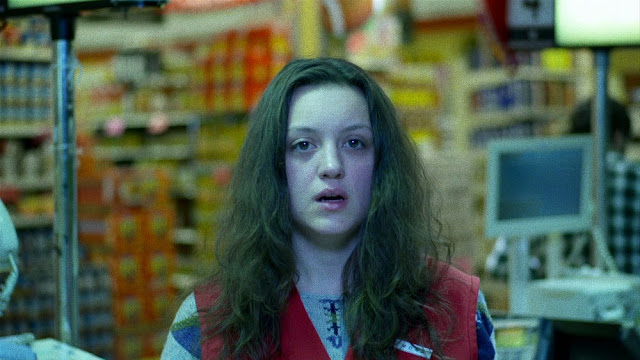
Although hardly unknown within indie film circles, the films of Frank V. Ross remain under the radar for more mainstream audiences. His new film, Tiger Tail in Blue (2012), represents his seventh feature since 2000, yet Ross, whose films have been associated with those of Joe Swanberg and Andrew Bujalski, has had trouble getting his films distributed more widely, despite playing at SXSW and other notable venues. Hopefully this is about to change. Tiger Tail in Blue was nominated for the “Best Film Not Playing at a Theater Near You” Award at the recent Gotham Independent Film Awards, and rated number five on the “Best Undistributed Films of 2012” list on Indiewire.

While showing similarities to films associated with mumblecore, Ross’s work mines somewhat different territory. In contrast to fellow Chicagoan Joe Swanberg, for example, Ross carefully scripts his films, even though they might easily be mistaken for being improvised. If early mumblecore films dealt with the confusion of twentysomethings jumpstarting their adult lives, Ross’s characters seem to be a very different breed. They are less urban hipsters in a transitional stage of life than young, working-class suburbanites, who find themselves already trapped in humdrum lives and less than satisfying routines. They accept their fates with a certain resignation, yet feel stymied and unfulfilled as they struggle to make ends meet in a world of diminished prospects.

In Hohokam (2007), which is set in sweltering Phoenix, Anson (Anthony J. Baker) is an ex-marine working as a laborer, while his girlfriend Lori (Allison Latta) is stuck in a cramped office cubicle where she haggles on the phone with customers about their late medical payments. Anson has aspirations to start a restaurant or a car wash, but it’s not clear that he has the necessary drive, skills or luck to make that happen. To make matters worse, even Lori has her doubts. In Audrey the Trainwreck (2010), Ron Hogan (Baker), works as a purchaser for an ATM parts company, while the new girlfriend he meets on an Internet dating site, Stacy (Alexi Wasser), delivers parcels. It turns out that Ron hates his job, but can’t admit it to himself. In fact, he’s already secretly counting the days to early retirement (the working class dream), even though he’s only been employed there for three years.

If dead-end jobs largely define the worlds of Ross’s characters, they also consume so much of their lives that they don’t have much time for leisure. But the characters also appear to live in a cultural and artistic vacuum. In Hohokam, Anson and Lori decide to go out on the town and do something, but they are somewhat at a loss to figure out what that might be. For lack of anything better to do, they end up visiting the local zoo. In Audrey the Trainwreck, Ron spends time in coffee shops and dark bars. Beyond that, he plays volleyball with co-workers, while Stacy attends a bridal shower. The main characters in Tiger Tail in Blue go sledding down a not-very-steep hill.

What’s unique about Ross’s films is the way he deliberately eschews classical narrative. There’s no catalyst or inciting incident 10 or 15 minutes into the film to propel the story forward. In fact, there’s not much story per se. Viewers expecting a dramatic premise might question exactly what it is they’re watching. Yet Ross merely has a different agenda. He’s less interested in story conventions than in exploring the boundaries of narrative. At times, he even teases viewers by playing with their expectations. There is Anson’s gun, Lori’s flirtatious officemate, and another co-worker named The Jeffery (Joe Swanberg), who weasels a ride home from Lori early in Hohokam. Plotwise, these all turn out to be red herrings. In Audrey the Trainwreck, Ron’s roommate, Scott Kaniewski (Danny Rhodes) appears to have a crush on him, but this doesn’t lead anywhere either, and is treated as a simple fact of life. If there’s a story there, Ross chooses not to tell it.

Ross seems to exult in chronicling the ordinary or the mundane. He gives equal weight to what would be excluded in most other films: bodily functions, pumping gas, office rumors, a phone call from a child that turns out to be a wrong number, breaking a favorite coffee mug, an older couple dancing in a restaurant, the surprise of getting a buffalo head nickel, the pleasure of a doughnut break or eating ice cream, the annoyance of cell phones, or a bad case of shingles. Ross’s characters talk very matter-of-factly, even provocatively, about sex, but the erotic pleasure appears to be more in talking about it – the possibility of sex – rather than actually engaging in the act. Any declaration about making love becomes an empty threat.

The sense that Ross’s characters feel trapped in their suburban lives and by jobs that “suck the life out of them” probably accounts for the fact that they get easily annoyed by little things. Ron gets upset about restaurants that claim to have the best hamburgers; the bride-to-be complains to Stacy about a parent interfering with her wedding plans. Chris in Tiger Tail in Blue gets irritated by older folks who call him “dude,” while Brandy’s roommate, Leonard (Baker), is convinced that reality television is making kids stupid. Scott launches into a long tirade, lasting several minutes, about security screenings of children at airports. He insists he’d rather be blown up than subjected to such “indignities.” “Just agree with me,” Scott heatedly vents to Ron, “that kids taking off their shoes at airports equals a shitty world.”

Ross’s characters also tend to have very short fuses. Lori and Anson get into an argument over an offhanded racist comment. Lori’s failure to approve of Anson’s choice of clothes leads to a blowup that causes her to storm out of the house. During a game of volleyball, Ron angrily throws the ball at his co-worker Jeremy (Swanberg) after he slips on water that Jeremy accidentally spills on the court. Ron argues with Scott, and also gets into an altercation at the local bar with a smug contractor named David (Nick Offerman), who belittles the significance of Ron’s line of work. It’s the kind of situation we fully expect will escalate into a fistfight, but, in this case, David’s wife wisely intervenes before the two come to blows.

Ross’s films present slices of life rather than conventional narratives. They are not easily summarized or explained. In some sense they are character studies of couples. Anson and Lori seem to be a mismatched pair. They don’t have very much in common, and she finds it weird that he walks around with a loaded gun. In fact, Lori seems to share greater camaraderie with her gay friend, Guy (Rhodes) than with Anson. Audrey the Trainwreck explores the life and frustrations of a single guy who’s starting to get up there in age, but is still on the prowl, painfully aware that the clock is ticking and his prospects are narrowing. Tiger Tail in Blue examines the pressures of everyday life on a young married couple in suburban Chicago.

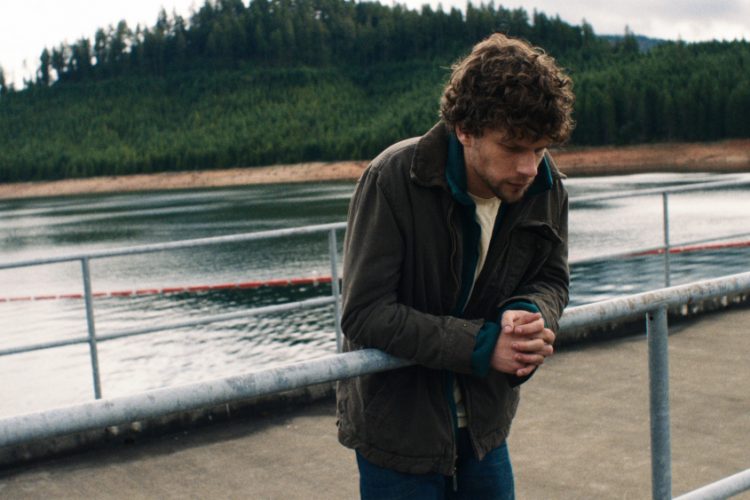
Tiger Tail in Blue feels less angry than Ross’s previous films. If Audrey the Trainwreck accentuates warmer, yellow and orange hues, Mike Gibisser’s assured cinematography gives the new film a cooler, bluish look, as befits the melancholic mood suggested by the title, and which is reinforced by the jazz score by Mike Medeski and Chris Speed. Ross has always excelled at getting strong naturalistic performances from his actors, and Tiger Tail in Blue uses an ensemble cast – Ross himself and Rebecca Spence, along with Megan Mercier and Anthony Baker in a cameo – to great effect. Ross continues to be the master of throw-away lines. If the anger has dissipated somewhat, it nevertheless lurks just under the surface, so that Tiger Tail still retains its edge. Ross is keenly observant of human behavior. The simplicity of Tiger Tail turns out to be a deceptive mask.

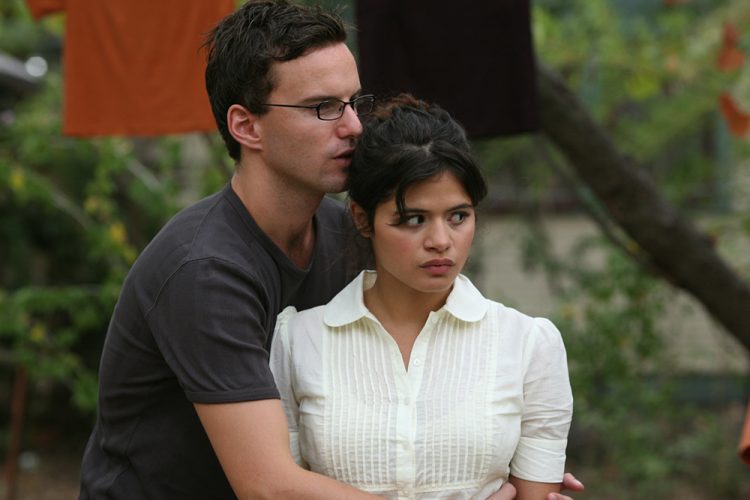
In Tiger Tail in Blue, Chis (Ross) is an aspiring writer, who also works nights as a waiter, while his wife, Melody (Rebecca Spence), is a high school teacher. As a result of their conflicting schedules, the two hardly see each other. Melody is already asleep by the time Chris gets home, which puts strain on their love life. Not only do their different work schedules create enormous tension between them, but Chris also flirts with a co-worker named Brandy, which causes him to linger at the restaurant even longer. Melody resents Chris’s aspirations to be a writer, especially because it affects them financially. To her, his pursuit of writing is a luxury they can’t afford. When Chris is late coming up with his share of expenses, it leads to a spat. They also get into an argument later when Chris needs Melody to give him a ride home after he has his eyes dilated. Melody’s resentment becomes evident when she refers to their health insurance as “my” insurance. She’s the one who has the job with benefits, even though she might not be able to keep it long-term.

Ross’s films have cryptic titles. They don’t actually describe the films they represent, but rather resonate in idiosyncratic ways. Hohokam suggests that Phoenix is less a mecca for young singles than a dying civilization. Audrey the Trainwreck refers to a drunken woman on the dance floor that Scott describes to Ron, while Tiger Tail in Blue alludes to the type of doughnuts that Chris and Melody eat on the street. For this couple, stopping for doughnuts represents one of the few pleasures in life that breaks the monotony of their daily grind. Ross’s films usually incorporate unexpected elements. In Tiger Tail in Blue, the film’s naturalism is confounded by the fact that Spence plays not only Chris’s wife, Melody, but also Brandy, the waitress with whom he works.

While this is initially confusing, a different actress (Megan Mercier) takes over the role at two crucial points in the film. The first occurs when Melody pays an unexpected visit to the restaurant; the second happens when Chris comes over to Brandy’s house to borrow a CD. Ross is not the only filmmaker to cast the same performer in different roles, but a viewer might question why he employs this unusual strategy here. Ross’s point seems to be that Chris’s feelings toward Melody and Brandy are tempered by the situation. Work allows Chris and Brandy the space to enjoy each other’s company, whereas the responsibilities of marriage conspire to snuff out the spark of romance between Chris and Melody.

Ross, in fact, states it bluntly in an interview with Hammer to Nail: “I mean, romance goes away at a certain point. You displace your feelings after a certain amount of time, it’s kind of like, ‘Oh wasn’t it fun when we did this?’ But it’s a new relationship now, and if you can’t enjoy it, you’re going to, you know, do what happens in the movie.” The film’s loopy song-and-dance number perfectly embodies Chris’s personal dilemma. A curious amalgam of a Fred Astaire and Ginger Rogers musical and a John Wayne western, the scene is so playful and exhilarating that its tonal shift catches us completely by surprise.

Along with Amy Seimetz’s Sun Don’t Shine (which was just acquired by Factory 25) and Dan Sallitt’s The Unspeakable Act, Tiger Tail in Blue strikes me as one of the best indie films to surface in the past year. The film will play at the Gene Siskel Film Center in Chicago later this month and at the Wisconsin Film Festival in April.

Posted 18 January, 2013

San Diego Surf

Andy Warhol, San Diego Surf, 1968/1996, ©2012 The Andy Warhol Museum, Pittsburgh, PA, a museum of Carnegie Institute. All rights reserved.

San Diego Surf (1968) is one of the later films from the period in which Andy Warhol made sexploitation films. These include: My Hustler (1965), I, a Man (1967-68), Bike Boy (1967-68), The Loves of Ondine (1967-68), The Nude Restaurant (1968) Imitation of Christ (1967-69), Lonesome Cowboys (1967-68) and Blue Movie (1968). In terms of chronology, San Diego Surf falls between Lonesome Cowboys and Blue Movie, Warhol’s final work as a director. Both Lonesome Cowboys and Blue Movie would run into censorship problems, but San Diego Surf, which was filmed shortly before Warhol was shot and seriously wounded by Valerie Solanas, was never released. Now, forty-four years later, the film has been restored and finally makes its debut on October 16 at the Museum of Modern Art, where it will be introduced by the legendary Taylor Mead, who starred in it. The film will have an extended run at the museum from January 23–28, 2013.

Although the sexploitation films were initially dismissed by many critics and scholars, a revisionist perspective on this body of work has emerged over the years. In his book, Andy Warhol and the Can that Sold the World, Gary Indiana, for instance, writes: “Whatever else could be said of them, [the sexploitation films, or what he deems ‘the crypto-narrative talkies’] are among the most audaciously, emphatically spellbinding displays of polymorphic sexuality and verbal frankness in film history, in part because of the camera’s, or the director’s, disregard for continuity or narrative construction, the inclusion of unintelligible stretches of sound track, the pockets of total silence, the use of stuttering zooms, and, confuting their deliberately amateur qualities, a mixture of innovative and classical framing, the inclusion of synechdotal  figures and evocative objects at frame edges, and the improvisatory brilliance of actors provided with the sketchiest story premises to work within (when they remember to).”

The plot of San Diego Surf will certainly strike viewers as “sketchy.” Viva is married to Taylor Mead, a rich property owner who is supposedly a golf and tennis champion, but he can’t manage to climb the social ladder of La Jolla because he’s not a surfer. On the verge of getting divorced from Viva, Taylor indicates that he plans to marry Nawana Davis, an irresistible dancer who is the “wealthiest girl in La Jolla.” Nawana, however, considers Taylor to be a stalker, but she’s trying to give him some “soul.” Despite Taylor’s professed interest in her, he really has his eye on two men: Joe Dallasandro, a newcomer who’s also trying to learn how to surf, and Tom Luau (Tom Hompertz), a local Hawaiian surfer. A subplot involves Ingrid Superstar, who might be two months pregnant, and Viva’s attempts to find her a husband, even though Ingrid already has a steady boyfriend, Eric Emerson, who admits that his three previous marriages were a way of compensating for his homosexuality.

In one memorable scene, Taylor sings a song to a baby whom he holds in his arms. Viva complains to Joe that Taylor is not a caring parent. After she takes the infant from him, Taylor suggests that if he and Joe have a baby, he’ll be better, to which Viva mockingly replies, “In whose womb?” We hear the sound of motorcycles outside, which causes her to launch into one of her infamous tirades: “Damn motorcycles out there. The whole neighborhood’s going to pot. First they let the hippies in. Then they let the motorcyclists in. The next thing you know we’re going to have the Ku Klux Klan racing down the streets.” As Viva scoops up another child, the baby suddenly slips out of her arms, but Joe somehow miraculously manages to catch the falling infant. Obviously ruffled, Viva blames Taylor, who quickly retorts, “You were nearly a complete failure as a mother.”

Warhol films are notorious for their unpredictability. The near catastrophe of the baby slipping out of Viva’s arms, in many ways, epitomizes that element. Yet it contrasts with the staged quality of the inhibited Tom Hompertz pretending to urinate on Taylor Mead later in the film – an act that was accomplished through editing. It represents one of the few instances in Warhol films that seems to runs counter to everything his films seemed to stand for. In the scene, Taylor lies on a surfboard and begs Tom to urinate on him. Tom discreetly takes down his pants and stands up, so that the framing only shows his legs. While Taylor pretends to masturbate and squeals about suffering and the cruelty of surfers, his face is sprayed with a foamy liquid (beer). Taylor is clearly ecstatic at what he considers to be his initiation into surfing and insists that he’s “a real surfer now.”

Warhol seemed well aware of the shortcomings of San Diego Surf. He wrote: “Everybody was so happy being in La Jolla that the New York problems we usually made our movies about went away—the edge came right off everybody.” Interestingly, he adds: “From time to time I’d try to provoke a few fights so I could film them, but everybody was too relaxed even to fight. I guess that’s why the whole thing turned out to be more of a memento of a bunch of friends taking a vacation together than a movie. Even Viva’s complaints were more mellow than usual.” Joe Dallesandro has suggested that there wasn’t a very clear idea for the movie prior to filming. Looking at the material, it’s hard to imagine how the film could have been interesting given its narrative premise and lack of a central core. Victor Bockris attributes the film’s failure to the influence of Paul Morrissey. He indicates that Viva appealed to Louis Waldon “to beat the shit out of him and save this film from his cheap commercial tricks.”

San Diego Surf is a surfing movie that doesn’t show feats of surfing or, for that matter, even big waves. That might sound Warholian on some level, but here it works against the film for the simple reason that the shots of the ocean are merely intercut with the narrative. Warhol wasn’t interested in fidelity to genre expectations per se. After all, he worried that Horse, which was shot in the Factory, was too much “like a real Western.” Like Horse, San Diego Surf could have been shot entirely in the Factory. But because the film is shot on location, audience expectations change. In Lonesome Cowboys, the pop-top cans of soft drink, sounds of airplanes, filtered cigarettes, allusions to Superman, and so forth, announce the film’s contrivance, whereas San Diego Surf actually pretends to be something that it’s not. Warhol must have realized this because that certainly wasn’t the case with his next film, the notorious Blue Movie, in which Viva and Louis Waldon don’t pretend, but actually engage in sexual intercourse on camera.

San Diego Surf is not without interest in Warhol’s film career. It’s a transitional work. Although it lacks Warhol’s patented strobe cuts, idiosyncratic framing and camera movement, the film nevertheless features many of his most famous later superstars: Viva, Taylor Mead, Louis Waldon, Joe Dallesandro, Eric Emerson, Ingrid Superstar, as well as Tom Hompertz. For me, even a minor or unsuccessful Warhol film contains aspects that make it intriguing to watch. Warhol’s films were high-wire acts that contained the risk of possible failure, which was a crucial element of his conceptual and aesthetic approach to film. You have to respect Warhol for that. Most filmmakers simply aren’t that daring.

Note: For more detailed coverage of Andy Warhol’s films, including the sexploitation films and San Diego Surf, please see my new book The Black Hole of the Camera: The Films of Andy Warhol (University of California Press, 2012).

Taylor Mead, Viva, Joe Dallesandro, and Paul Morrissey recall the making of San Diego Surf in Interview.

Posted 14 October, 2012

The Unspeakable Act

In discussing his new film, Yellow (2012), Nick Cassavetes recently made headlines at the Toronto Film Festival after he told an interviewer: “Love who you want. Isn’t that what we say? . . . If it’s your brother or sister it’s super-weird, but if you look at it, you’re not hurting anybody except every single person who freaks out because you’re in love with one another.” The provocative title of Dan Sallitt’s The Unspeakable Act (2012), which deals with a similar subject matter, turns out to be something of a smokescreen. The topic might be loaded – as evidenced by the intense reaction that Cassavetes’s comments managed to elicit – but Sallitt’s Rohmer-inspired film is actually a very sober look at the issue of sexual desire between siblings.

The Unspeakable Act begins with seventeen-year-old Jackie Kimball (Tallie Medel), riding her bicycle through the tree-lined streets of what looks like a suburban Midwestern neighborhood, but turns out to be the Midwood Park section of Brooklyn. We hear her voiceover narration: “In the spring of 2011, at the age of eighteen, my brother Matthew got his first real girlfriend. I had somehow thought that he and I had an unspoken agreement that we belonged to each other, which was really pretty stupid of me.” Family tension soon becomes evident when her mother (Aundrea Fares) and sister, Jeanne (Kati Schwartz), fail to greet her as they busily prepare dinner in the kitchen, and Jeanne then explodes over Jackie’s complaints about having to help.

Shortly after this, Matthew arrives with his new girlfriend, Yolanda (Caitlin Mehner). Jackie initially monopolizes Yolanda, leaving the others to stand in awkward silence. In the midst of superficial banter during dinner, Jackie excuses herself to vomit in the bathroom in a wide shot that frames her enclosed by vertical lines. As Jackie and Matthew later smoke cigarettes together, Jackie demands to know whether he really likes Yolanda better than her. Matthew answers that he hardly knows Yolanda, but he really wants to have normal sexual relationships. Jackie answers: “Yeah, I know. You want to grow up and have mature adult relationships, not immature stunted ones like ours.” She ends up crying in his arms.

At the heart of The Unspeakable Act lies the complicated relationship between Jackie and her older brother. The surprise is that Jackie refuses to hide her feelings for Matthew. For her, it’s a given fact and something of a badge of honor; for him, it’s clearly a source of great personal conflict. The Princeton-bound Matthew is intensely shy and introspective, but he’s also very sensitive to the feelings of his sister. Although Jackie worships Matthew, no one else does, so it’s obvious that Jackie’s deep affection for Matthew bolsters his self-esteem. Not surprisingly, he and Yolanda, after sleeping together, break up soon afterward. As he tells Jackie, “My theory is she didn’t really want to be in a relationship; her theory is different.”

Considerably shorter than her mother and siblings, even physically, Jackie seems not to fit into the menagerie that constitutes her family. Mrs. Kimball appears depressed, speaks little, and has retreated into writing a journal. She idolizes her oldest son, Will, who lives in Paris, and spends a great deal of time writing long letters to him. Mrs. Kimball’s spirit appears to have been broken long ago. Jackie alludes to her mother’s past drug addiction, but character motivation for Sallitt, for the most part, is buried, and, as in real life, an elusive proposition. Jeanne, on the other hand, goes to community college and spends a lot of time with her boyfriend, Charles, whom we only see from a distance as he picks her up in his car. It is little wonder that Jackie would gravitate toward Matthew, who’s smart like her, and whom she insists is the “best person” she knows.

The Unspeakable Act might be the only film with a series of therapy sessions that is not really a psychological film. None of what is uncovered in the various sessions really explains Jackie either. Sallitt appears to be much more interested in philosophy than in psychology. Like Eric Rohmer, he believes in a dialogue-driven cinema based on language. Sallitt appears to be more interested in surfaces than in subtext. If most dramatic films use the latter to provide the undercurrent of energy behind scenes, while someone like John Cassavetes exploits repeated tonal shifts to propel scenes forward, Sallitt employs spoken language as a means for characters to give voice to their feelings. In a sense, language empowers characters like Jackie, who have a way with words.

In All the Ships at Sea (2004), the only other Sallitt film I’ve seen, a young woman, Virginia (Edith Meeks), returns after being expelled from a cult. She spends time at lakeside cottage with her older sister, Evelyn (Strawn Bovee), a Theology professor. After Virginia interrogates Evelyn about Catholic religious doctrine, she explains her own beliefs, which reflect those of the cult. As Evelyn sits and knits against a backdrop in which we can view two men fishing on the water, Virginia’s strong conviction and verbal dexterity bludgeon Evelyn into a personal crisis of faith. In a sense, Jackie’s insistence of her love for Matthew also overwhelms him. Toward the end of the film, he acknowledges her tremendous power, suggesting how easy it would be for him to succumb.

Every move Matthew makes to escape from Jackie causes her to experience a deeper personal crisis. Before he leaves for college, the two of them attend a concert in Prospect Park with another couple. Matthew and his nerdy pal, Tony (Mike Faist), argue about the significance of contemporary writers. Tony mocks Matthew for favoring Don DeLillo over Thomas Pynchon. Jackie, on the other hand, simply relishes the experience of the outdoor concert as a kind of date. As Matthew questions her about her fantasy of the two of them as they sit on a park bench, he asks Jackie whether it includes kids. It doesn’t, but she laments, “You certainly know how to kill the mood.”

After Matthew leaves for Princeton, Jackie experiments with sex with a classmate named Tristan (Colin Summers). In the name of openness, she shares the details of her sexual escapades with Matthew via email. When Matthew comes home from school for vacation, however, Jackie disses Tristan to be with her brother. But when Matthew finally threatens to withdraw his affections from Jackie, the thought of this becomes utterly unbearable and she panics, which leads to the film’s conclusion.

Brooklyn-based Tallie Medel seems perfectly cast as Jackie. There is no sense of mystery about what she thinks or feels. She’s blunt and outspoken almost to a fault; her candid remarks come at a velocity most people would find disarming. Or as Jackie puts it to the therapist, Linda (Caroline Luft), “Yes, I have this bad habit of embarrassing everyone by just blurting things out.” Yet Jackie, as played by Medel, is also incredibly vulnerable, because she doesn’t have the normal defenses most people do when it comes to her innermost thoughts and feelings.

If Medel is key to the film’s success – and her performance here proves she’s a rising young star — the supporting actors deserve enormous credit for their comparatively understated performances. The acting in Sallitt’s film strikes me as a type of stylized realism. The performers don’t seem like actors at all, but are more like real people. Even though the dialogue is scripted rather than improvised, they exhibit very little affect – the level of artifice has been toned down considerably. Sky Hirschkron, for example, plays Matthew as a character who needs to reflect before nearly every measured response. When Jackie comments about that the fact that he never cries, Matthew responds, “If I cried too, this house would be like washed away.” Hirschkron says the line so matter-of-factly that we suddenly glimpse the immense sadness of this character.

Sallitt is also a well-known film critic, who has written eloquently about improvisation in Joe Swanberg’s films. In discussing Silver Bullets(2011), he writes: “Even more noteworthy is the way that all these improvisations refuse to sacrifice the integrity of the characters’ positions for easy effect. The feelings underlying the characters’ stances are sufficiently complex that the characters naturally waver or double back on themselves under the pressure of relating to each other, and yet are sufficiently consistent that the duels lead to standoffs, to silences that require effort to dislodge.” It strikes me that perhaps the same thing could be said about the characters’ responses to each other in The Unspeakable Act.

Sallitt’s film is much more formally rigorous than any of those by Swanberg. The camera doesn’t move. The careful framings by cinematographer Duraid Munajim create rectangles within rectangles, indicating how trapped Jackie is by her feelings for Matthew. The film’s palette is determined largely by the colors of the Kimball family’s large green and yellow Victorian house. Sallitt holds on shots longer than most directors. Characters often exit the frame, but Sallitt sticks with a shot as long as possible before cutting to the next one. He avoids non-diegetic music, which allows scenes to play without additional emotional resonance. In terms of framing, shot duration, and the long silences between characters, Sallitt appears just as much interested in the negative space as he is in the positive.

The mystery and surprise of The Unspeakable Act is how such a cerebral film can be so emotionally affecting. It is currently playing the festival circuit and screened at BAMcinemaFest this past summer, but this low-budget indie gem deserves to be seen more widely. This impressive feature provides strong evidence that Dan Sallitt is one of the most underappreciated major American indie writer/directors out there.

Posted 26 September, 2012

Beasts of the Southern Wild

No independent film this year has received more fanfare than Beasts of the Southern Wild (2012), which was directed by Benh Zeitlin and made in collaboration with a collective of artists based in New Orleans. The film won the Grand Jury Prize at Sundance as well as the Camera d’Or for Best First Film at Cannes this spring. Based on a play by Lucy Alibar, who co-wrote the script, Beasts of the Southern Wild feels like less of a conventional narrative than a visual poem in the tradition of Terrence Malick. Shot in southern Louisiana, the film recalls the devastating effects of Hurricane Katrina, but its scope is much broader. It is about one’s attachment to place, a mythic exploration of the defiant human spirit and the precariousness of life in the face of threats posed by the natural world.

The film centers on a six-year-old named Hushpuppy (Quvenzhané Wallis), who lives in a flood plain called “The Bathtub.” The area is separated from the mainland by a government-built levee, which has isolated the area even more and aroused contempt in those who remain there. Even though they realize that they’re extremely vulnerable and ultimately doomed in the event of a major flood, the eccentric residents remain steadfast in their refusal to abandon their homes and primitive way of life. Indeed they have created an entire mythology to sustain themselves. The folks in the Bathtub scorn and ridicule those protected by the levee. They believe that they are strong, even heroic, while they consider the others to be wimps.

Hushpuppy lives in an enchanted world close to nature. For her, everyday is a holiday. She feels sorry for the folks on the other side of the levee, who don’t have many holidays, eat fish that comes in packages, and exist in the shadow of ugly oil refineries. Hushpuppy lives with her father, Wink (Dwight Henry), an irascible and very ill drunk, whose cruelty to his daughter is a way of preparing her for the time when he will no longer be there. Hushpuppy’s mother has already abandoned the family. According to the little girl, who narrates the film, her mother just swam away one day. Wink has created additional folklore surrounding Hushpuppy’s mom, whose beauty was powerful enough to ignite the burners on the stove.

Hushpuppy’s conflicted relationship with Wink is mirrored in the fact that they live in separate ramshackle trailer houses until she burns hers down. When she is forced to move in with Wink, he draws a strict boundary line. Because Hushpuppy has become a huge burden – “you’re killing me,” he complains bitterly at one point – he tries to get rid of her, but the two of them nevertheless share a strong bond – his cruelty toward her is actually a form of caring. Wink indoctrinates Hushpuppy with tactics geared toward survival. He slaps her, throws things at her, and gets her to flex her muscles and repeatedly shout “I’m the man.” When a neighbor tries to show her the proper way to eat a crab using a utensil, Wink irately insists that she “beast” it instead, which is his term for eating it with her hands.

Early in the film, Hushpuppy picks up a chicken and a crab, puts them to her ear and listens intently. She claims to understand what they’re saying, but admits that they sometimes speak in code. A bizarre lecture by her teacher causes Hushpuppy to identify with prehistoric beasts known as aurochs. These large boar-like creatures with tusks posed a threat to the early cave dwellers. As a result of global warming, the aurochs eventually get released when the icecaps melt, and, through special effects and the film’s own brand of magic realism, eventually confront our young heroine as well.

Beasts of the Southern Wild is told through Hushpuppy’s naïve and innocent point of view. Hushpuppy is convinced of her own self-importance and that in a thousand years scientists will know about her life. She believes that everything, even the smallest part of the universe, fits harmoniously together. But she is eventually forced to readjust her world view once the inevitable flood wipes out their neighborhood, causing residents to exist on makeshift boats amidst an ecological disaster. Wink concocts a plan to take revenge against the levee, but the residents of the Bathtub are eventually taken against their wills to a government shelter. Because the rag-tag interracial group of adults and children cannot be civilized, their only recourse is to flee back home.

The politics of the film are a curious mixture of anarchism, subcultural resistance, and what could easily be interpreted as a Tea Party-like hostility toward government. There’s no denying, however, that the film’s sentiments stem from a deep love of the environment and this particular place. The film operates on the level of myth. What’s amazing about Beasts of the Southern Wild is its epic sweep. In the mold of Tom Sawyer and Huckleberry Finn, Hushpuppy becomes a pint-sized embodiment of untamed and rugged individualism. This adorable little girl, with her white rubber boots, short pants, and hair illuminated by golden light, is clearly a force to be reckoned with. She’s been conditioned by her situation to be as tough as nails and ultimately proves to be unafraid of the giant aurochs.

Quvenzhané Wallis gives such an extraordinary performance that it’s impossible to take your eyes off her. It seems downright uncanny that the face of a young child can register such a wide range of emotions, while Dwight Henry manages to convey a remarkable depth of intensity. It’s not surprising that Henry refused to abandon his store during Katrina, or that scenes in the film were rewritten based on Henry’s own personal experiences. Yet it’s Wallis in the form of Hushpuppy who steals our hearts.

It’s hard to think of another low-budget independent film in recent years that has quite the ambition of Beasts of the Southern Wild. Who would dare to conceive of such a complicated film, especially one that relies on special effects, unless you had unlimited capital and the backing of a major studio? Who would cast a six-year-old nonprofessional as the film’s lead, alongside the owner of a local bakery? Given the high degree of difficulty, you have to wonder how Zeitlin and his cohorts were able to pull off this impressive feat, and still live to tell about it.

Posted 5 August, 2012

The Innkeepers

In shooting the horror film, House of the Devil (2009), Ti West and his crew stayed at a historic 19th century hotel called the Yankee Pedlar Inn in Torrington, Connecticut. When a big studio ghost movie West was scheduled to direct fell through at the last minute, this location became the inspiration for his own low-budget one. The resulting film, The Innkeepers (2012), uses the architecture of the sprawling hotel – its long corridors, maze-like staircase, and pitch-black, cavernous basement – to create a sense of suspense in telling the story of two slackers who work at the haunted hotel.

Ti West has become one of the leading young indie directors making horror films today. What distinguishes his work, especially The Innkeepers, is his concern for rich characterization, as well as the intriguing ways he riffs on the genre. The film has a formal elegance, which is evident in how West deals with the location spatially through careful framing and mobile camera work. The opening credit sequence contains a montage of historical photos of the interior and exterior of the hotel, set to a Bernard Hermann-like score by Jeff Grace. The film is divided into chapters, conveyed through titles that suggest silent cinema.

In a high-angled wide shot, a young woman, Claire (Sara Paxton) walks toward the imposing building. It’s the final weekend before the hotel is scheduled to go out of business. As Claire hangs up her winter parka, her co-worker, Luke (Pat Healy), saunters out, eating a stick of beef jerky. He says ominously, “So this is it, huh, just you and me . . . end of days?” Shortly after this, Luke insists he has something to show her on his laptop. As she stares at the screen and the camera moves in on an image of an empty rocking chair, Claire receives a scary jolt, which causes her to gasp for breath and reach for her asthma inhaler. West shows that he knows how easy it is to frighten an audience with cheap tricks, but the relationship between the two of employees is really what lies at the heart of The Innkeepers.

The contrast between them can be seen in their hairstyles. The older Luke sports a huge curl on top of his head that makes him look like a Kewpie doll, while Claire’s short blond hair is chopped off unevenly, as if someone gave her a haircut using garden shears. Luke is passive-aggressive. He concocts paranormal experiments involving evp recordings for the benefit of Claire, whom he secretly has a crush on. At the same time, in his dealings with her, he tries to hide this as best he can by adopting a cynical and grouchy veneer. He also gets his rocks off by constantly scaring her, so that he comes across as an annoying older brother.

When a well-known TV and film actress, Leanne Rease-Jones (Kelly McGillis), checks into the hotel and Claire gets overly excited, Luke appears to be indifferent. He shoves her hotel receipt at Claire disdainfully, and says, “Well, here’s your autograph, just relax.” But right after that, as she optimistically details her desire to make contact with ghosts on this final weekend of the haunted hotel, he gawks at her, as if moonstruck.

Claire’s relationship with the actress is equally conflicted. When Claire delivers towels to her room, an arm sticks out of the bathroom door, as the hotel worker swoons from such close proximity to a celebrity. The actress then seductively steps out from the shower with only a towel wrapped around her. “I’m a really big fan of yours,” Claire suddenly blurts out. The actress asks, “And what do you do?” The question causes panic in Claire, who stammers, “I’m kind of like, you know, in between stuff.”

Claire becomes distraught over the interaction, and admits to Luke, that “She kind of made me feel like an asshole.” Claire asks him, “Why do people have to have such high expectations?” He responds, “Everything happens for a reason, Claire. Nobody just ends up at the Yankee Pedlar.” That fatalistic comment might serve as the film’s mantra, especially once Claire becomes obsessed with finding the ghost of Madeline O’Malley, who committed suicide at the hotel and now haunts the place.

Leanne Rease-Jones turns out to have forsaken acting and is now a clairvoyant. Virtually everything she says is loaded with innuendo. Brandishing a crystal pendulum, she warns Claire, “You mustn’t go down into the basement,” before suddenly becoming evasive. Yet what good is it to foresee the future if you can’t do anything to change it? It’s the hotel’s third and final guest – an old man (George Riddle) with the craggy face of a walrus and a voice from the crypt – who ultimately sets the film on the path to horror. For nostalgic reasons, he insists on staying in the honeymoon suite on the closed third floor despite the fact that the room no longer has any furniture other than a bed.

If horror remains the main attraction of The Innkeepers for most viewers, the film exhibits a great sense of humor, so it’s not surprising that West refers to it as “a charming workplace comedy,” in which the horror element “kind of raises the stakes.” At one point, as she works the night shift, Claire becomes so frightened that she awakens Luke, but when he finally invites her into his room and she glimpses him in his underwear, she suddenly has second thoughts. Lena Dunham also makes a cameo as a barista with boyfriend issues. After Claire returns from her trip to the coffee shop minus a latte, Luke asks, “Does that annoying girl still work there?”

Sara Paxton and Pat Healy do a terrific job of conveying both the frustrations of their lowly status and the unresolved tensions in their relationship. Claire approaches situations with wide-eyed enthusiasm, even if she’s easily deflated, while Luke has conceded defeat years ago and has resigned himself to his fate. The most he can hope for in life, as Claire discovers, is watching online porn. Early on, Claire asks him whether he regrets dropping out of college. In a weary intonation, he responds, “Every day.”

It’s hard not to chuckle throughout The Innkeepers at the witty dialogue and all the odd little details of characterization. True horror fans might be disappointed with West’s more classical and stylized approach to a ghost movie and references to Stanley Kubrick’s The Shining (1980), but the film’s real innovation lies in the clever ways it deliberately plays against the more clichéd expectations of the genre.

Posted 24 July, 2012

« Previous Page
Next Page »